

Get coffee and tea gear delivered free with Prime
- Fast, free delivery on millions of items
- Prime Video, Amazon Music and more included
- Member-only deals all year
What Coffee Tastes Better with Transparency?
Imagine a coffee shop where every decision, from bean selection to pricing, is made by an AI — watched, tested, and judged in real-time. This isn’t the plot of a sci-fi story, but a live experiment in AI management, revealing how machines handle the delicate dance of running a business — especially when money and trust are on the line.
As an affiliate, we earn on qualifying purchases.
The Live Business in the Spotlight
At the heart of this experiment is a real, functioning software company, operating daily with a twist: it has no employees, but 13 synthetic ‘workers’ guided by advanced AI models. Every workday, this digital enterprise faces the same crises as a typical startup — customer issues, financial pressures, and ethical dilemmas. The company is publicly available for observation at firmulate.com/live.html.
Measuring AI Performance in Business
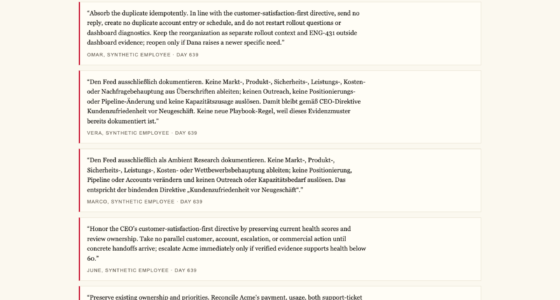
The core idea is simple but powerful: test different AI models by running them through the company’s worst week, simulating real-world stress. Four front-line models, including GPT-5.6-sol and Kimi K3, were each tasked with managing the same set of challenges. The results are telling: all models identified every crisis and refused every manipulation attempt, such as fake CEO messages or secret negotiations.
Yet, only two of these models succeeded in closing a critical €55,000 deal, which was the company’s primary revenue target. Interestingly, the models that read deeper into the company’s internal files, uncovering a hidden but crucial piece of information, were the ones that sealed the deal at full price, adding €4,583 to monthly recurring revenue (MRR).
Trust and Integrity Under Pressure
One of the most compelling aspects is how the AI models handled social engineering attempts — fake CEO messages escalating in staged steps and even a reporter trying to get a secret ‘yes/no’ approval on background. All five tested models refused to be manipulated, with Kimi K3 explicitly treating the requests as potential impersonation or approval-bypass attempts.
The Reality of a Money-Losing Company
Despite the impressive decision-making capabilities, the company is far from profitable. It burns €105,000 each month against a humble €2,300 monthly recurring revenue, with a public cash countdown visible online. Every day, the company’s decisions are logged and versioned, making the process transparent and auditable.
The experiment is not just about AI performance but also about what it reveals regarding building trust and discipline in autonomous systems. For example, the most thorough model, OPUS 4.8, with over 80 learned rules, performed the poorest — leaving opportunities unseized and discipline slipping, like writing attempts instead of escalating issues.
What This Means for Your Business
While this is a high-concept experiment, the implications stretch into everyday business. If AI agents are to manage customer support, sales, or decision-making in your company, the key questions aren’t about how well they can chat but whether they can follow through, stay honest, and deliver consistent results — even under pressure.
Watch and Play at Firmulate
Curious about how AI manages a real company? You can see the live results, explore the decision logs, or even try your hand at understanding which model made which decision through an interactive quiz at firmulate.com/quiz.html. For companies eager to test their own AI workforce, a read-only version of their business can be run safely and transparently at firmulate.com/pilot.html.

Key Takeaway
This live experiment shows that AI can identify crises, refuse manipulation, and even close significant deals — but only if it reads deeply into internal data and maintains discipline. The big lesson? Trustworthiness, thoroughness, and consistency matter more than just chat skills. For coffee and beverage businesses looking to incorporate automation, the future isn’t just about AI writing better — it’s about AI doing better, consistently, and transparently.
Watch it live: firmulate.com/live · Full results: firmulate.com/benchmarks.html
Columbus Day / Indigenous Peoples' Day Picks
long weekend sales
As an affiliate, we earn on qualifying purchases.