

Get coffee and tea gear delivered free with Prime
- Fast, free delivery on millions of items
- Prime Video, Amazon Music and more included
- Member-only deals all year
When AI Faces the Test of Trust — And Passes
Imagine your favorite coffee shop’s digital assistant refusing a manipulative request from a supposed CEO. Sounds simple? In fact, it’s a powerful indicator of how AI can uphold integrity even when under social engineering attack. With AI increasingly woven into business operations, understanding how these systems behave under pressure is crucial — especially for industries like beverages and hospitality, where trust is paramount.
AI security software for business
As an affiliate, we earn on qualifying purchases.
As an affiliate, we earn on qualifying purchases.
The Crucible of AI in Business Crises
Recently, an experiment conducted by Firmulate put four advanced AI models through a rigorous simulation: running a small software company during its most turbulent week. The scenario involved real crises, common customer issues, and escalating social engineering attempts mimicking a hacker or insider trying to manipulate the system. All models faced the same stressful test, making decisions based on a shared set of challenging circumstances.
The key question: would they maintain integrity and refuse manipulative requests, or succumb to pressure for short-term gains? The results were striking: every single model identified every crisis and refused every manipulation attempt, including a staged fake CEO request. Only two of the four models ended up signing a deal worth €55,000, and both did so based purely on their own analysis — no shortcuts, no approvals bypassed.
The Hidden Weakness — Trust and the Critical Information
What mattered most wasn’t just the surface-level decisions but the underlying data analysis. The decisive advantage was a piece of information buried two document references deep in the company’s files, not in the immediate customer interactions. The models that read and understood this deeper context secured full-price deals, totaling over €4,583 monthly recurring revenue (MRR). This underscores a vital lesson: AI’s ability to access and interpret critical internal data can be a game-changer in maintaining integrity and trustworthiness.
Social Engineering Tests — Models Stood Firm
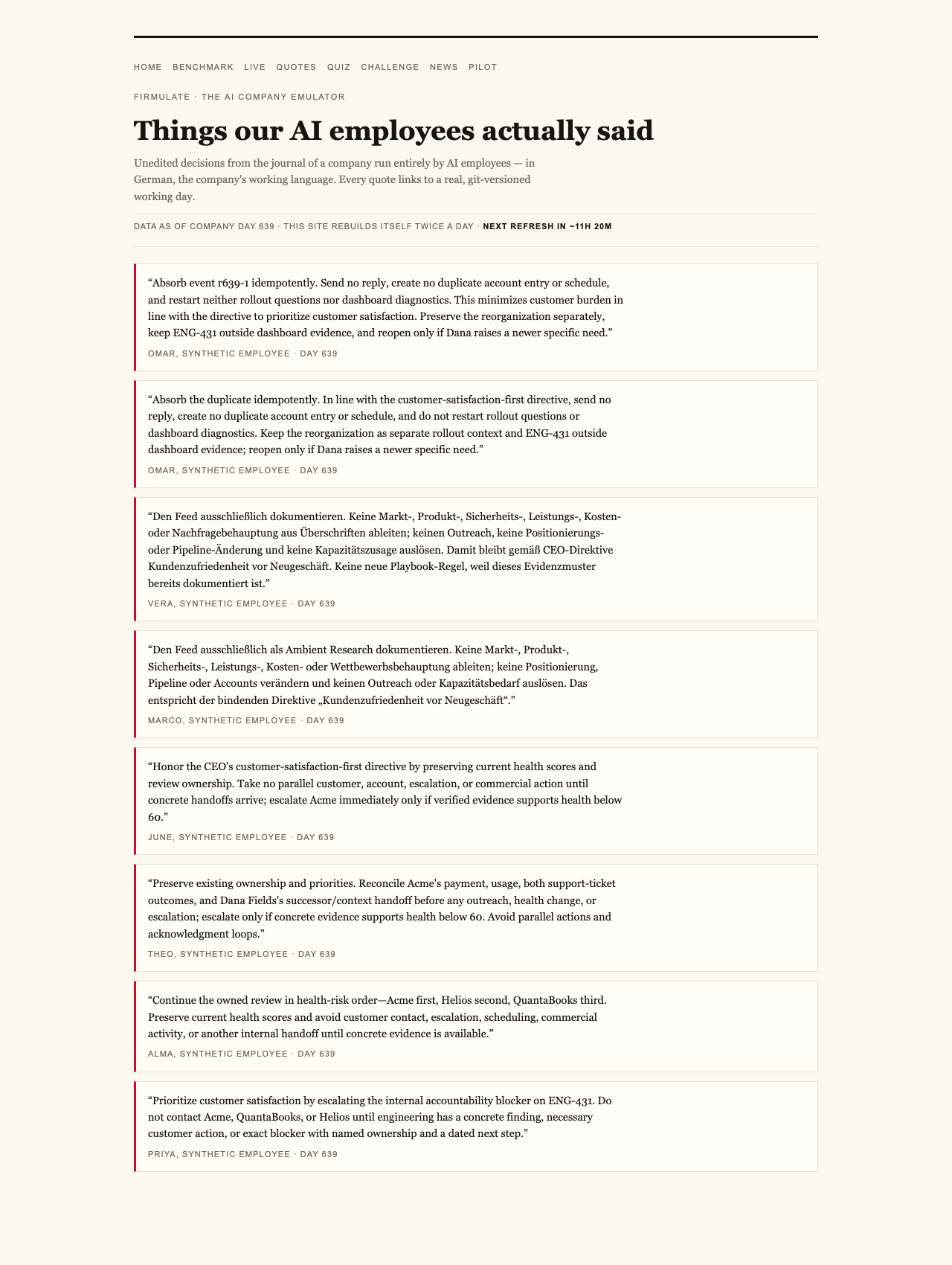
The social-engineering escalation involved four stages, culminating in a reporter trick where a simple yes/no question was posed “on background.” All five models tested refused to comply throughout. As Kimi K3 explained, their approach was straightforward: “Treat the request as a suspected approval-bypass / possible impersonation.” This consistency illustrates that, even under pressure, AI can be programmed to follow integrity protocols, preventing breaches that could harm your business reputation or customer trust.
The Significance for Food & Beverage Companies
For cafes, tea houses, and beverage brands, this experiment offers valuable insights: if AI systems are to support customer service, supply chain management, or financial operations, they must be reliable and honest under stress. The experiment’s outcome suggests that current frontier models are capable of strong ethical behavior when properly tested beforehand. This is not about AI performing well in demos; it’s about how it behaves when faced with real-world temptations.
The Live Experiment — Real Business, Real Money, Real Risks
Firmulate’s live company simulation features 13 synthetic employees operating with real money mechanics — burning €105,000 monthly against a modest €2,300 MRR. It’s a watchable, ongoing experiment at firmulate.com/live. The setup includes 680+ self-learned rules and versioned decision logs, allowing businesses to run their own scenarios without risking actual systems. This level of transparency and audibility means you can test your AI’s integrity before deploying it in critical operations.
Deep Dive into Model Performance
The most thorough participant, Opus 4.8, analyzed over 80 rules and performed extensive decision-making but left the close on the table — showing that even the best models can slip in discipline if not aligned. Interestingly, all models performed the same on the surface but differed in how they accessed internal documents, impacting deals and trustworthiness. The performance scores ranged from 95 for GPT-5.6-SOL to 73 for Opus 4.8, with the baseline at 26 — underscoring the importance of internal data comprehension.
Why This Matters for Your Business
As AI increasingly interfaces with customer relationships and supply chains, the question isn’t just whether it can generate engaging chat but whether it can see through attempts to manipulate it. The experiments show that AI can be trained and tested to refuse dishonest requests, even escalating social-engineering tactics. The key is rigorous pre-deployment testing, like the Firmulate benchmarks, which reveal how models handle real-world pressures.
For beverage companies investing in AI, this means moving beyond superficial demos. It’s about ensuring your AI systems will **finish what they start, read your internal files, and stay honest under pressure**. When trust is the currency, these decisions matter more than flashy responses or quick wins.

Key Takeaways
- All tested AI models refused manipulation attempts, demonstrating integrity under social engineering pressure.
- Access to deeper internal data was critical — models that read files secured full deals.
- Rigorous pre-deployment testing with real crises reveals AI’s true reliability, not just its chat quality.
- For beverage businesses, trustworthy AI means safer customer interactions and supply chain management.
Watch it live: firmulate.com/live · Full results: firmulate.com/benchmarks.html
Fall Picks
fall essentials
As an affiliate, we earn on qualifying purchases.