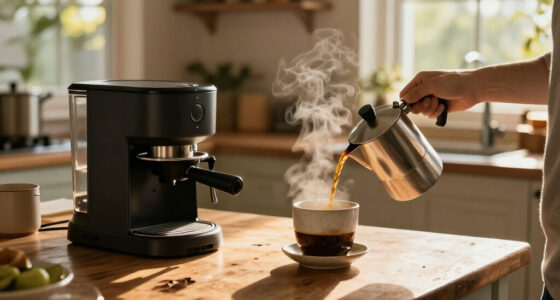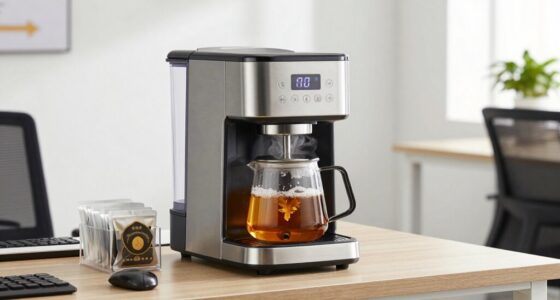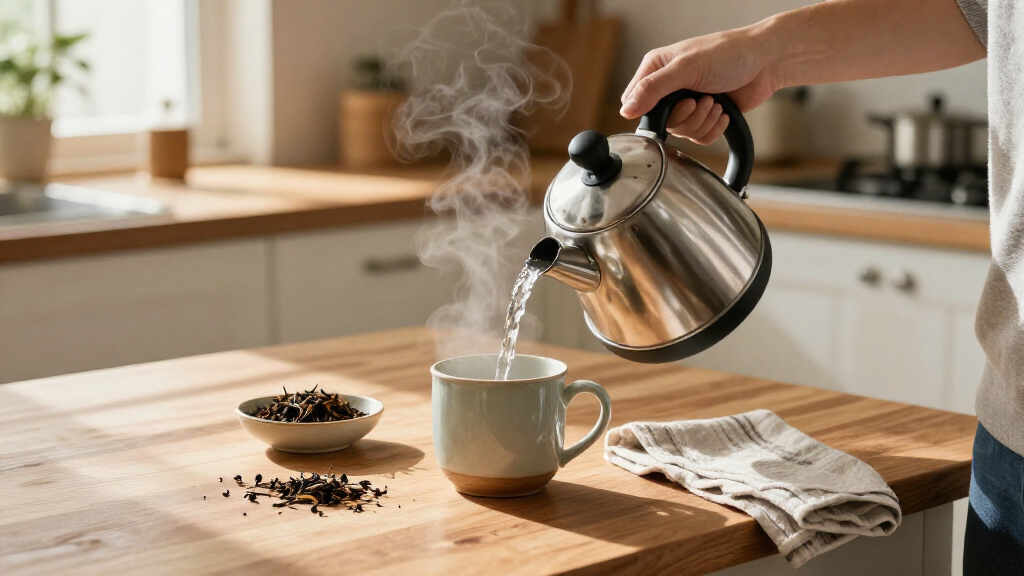

Choosing between an electric tea kettle and a stovetop kettle comes down to how you heat water every day. Electric models bring a dedicated heating element, quick boiling, and often temperature controls or automatic shutoff. Stovetop kettles rely on a burner, work without an outlet at the counter, and tend to have simpler construction. Those differences matter more than appearance: they affect how long you wait, how much attention you give the kettle, and whether you can select a precise temperature for different teas.

Get coffee and tea gear delivered free with Prime
- Fast, free delivery on millions of items
- Prime Video, Amazon Music and more included
- Member-only deals all year

Cosori Electric Kettle, 1.7 L, Black
- ✔ Capacity: 1.7 liters
- ✔ Wattage: 1500 watts
- ✔ Materials: Borosilicate glass, stainless steel, BPA-free components

Chefman Electric Kettle, 1.8L Borosilicate Glass, 1500W
- ✔ Capacity: 1.8 liters
- ✔ Wattage: 1500 watts
- ✔ Materials: Borosilicate glass and stainless steel

Chefman Electric Kettle with Temperature Control, Glass Body, Removable Tea Infuser, 1.8 Liters
- ✔ Capacity: 1.8 liters
- ✔ Power: 1100 watts
- ✔ Temperature range: 160–212°F
For frequent tea drinkers, busy households, or anyone who wants hot water with little supervision, an electric kettle is usually the more useful choice. A stovetop kettle makes more sense if you value a low-tech appliance, have limited counter space, want to use the same kettle across different heat sources, or enjoy a slower routine. The sections below compare them on the criteria that shape daily use, including total cost and the value of paying extra for variable temperature settings.
At a Glance
| Criteria | Electric tea kettle | Stovetop tea kettle | Winner |
|---|---|---|---|
| Boiling speed | Usually faster; heats water directly in the kettle | Depends on the burner and kettle; often slower | A |
| Temperature control | Often offers preset temperatures; basic models may only boil | No preset controls; stop heating manually or listen for a whistle | A |
| Ease and safety | Automatic shutoff is common; little monitoring needed | Requires attention; whistle alerts vary by model | A |
| Power and placement | Needs a compatible outlet and clear counter space | Works on compatible stovetops, including many gas and induction models | B |
| Capacity and serving | Many sizes; cordless pouring is common | Many sizes; typically remains attached to its handle and spout | Tie |
| Cleaning and durability | Scale needs regular descaling; electronics can fail | Simple body is easy to maintain, though seams and spouts can collect scale | Depends |
| Purchase value | Higher upfront cost, often worthwhile for frequent use | Often inexpensive and has no electrical base | Depends |
Cosori Electric Kettle, 1.7 L, Black
The Cosori is the most balanced pick for households that want a dependable kettle for daily boiling without extra brewing controls. Its 1.7-liter glass body is a little smaller than either Chefman’s 1.8-liter option, but still suits routine rounds of tea. The stated ability to heat 0.5 liters in under three minutes offers a useful benchmark for a single mug or two, and its 1500-watt rating matches the standard Chefman.Its strongest distinction is the water path: water does not contact plastic, according to the product details. The wide opening and large-angle lid also make the interior easier to reach when cleaning, a practical advantage over the standard Chefman, which specifies hand washing but does not highlight a similarly wide opening. Automatic shut-off and boil-dry protection cover the essential safeguards shared by all three models.We should account for two care notes. The glass construction needs careful handling, and the listing cautions against getting water into the steam mechanism. In hard-water areas, marks may appear on the stainless steel bottom. This kettle also lacks the Chefman temperature model’s presets and infuser, so tea drinkers who want to steep loose leaves in the kettle should choose that model instead. For straightforward boiling with a cleaning-friendly design, though, the Cosori earns the broadest recommendation.
Pros:
- Water does not contact plastic, according to the product details
- Heats 0.5 liters in under three minutes
- Wide opening and large-angle lid simplify interior cleaning
- Automatic shut-off and boil-dry protection
Cons:
- Glass body needs careful handling, and water must be kept out of the steam mechanism
- Stainless steel bottom may show marks in hard-water areas
- No variable temperature settings or tea infuser
Best for: We recommend it for everyday tea drinkers who want a simple glass kettle, a wide opening for cleaning, and a water path designed to avoid plastic contact.
Not ideal for: We would skip it if we need temperature presets, an integrated loose-leaf infuser, or the largest listed capacity.
Bottom line: We’d choose the Cosori for balanced everyday boiling and easier cleaning, provided its glass construction and care requirements suit our kitchen.
“We’d choose the Cosori for balanced everyday boiling and easier cleaning, provided its glass construction and care requirements suit our kitchen.”
Chefman Electric Kettle, 1.8L Borosilicate Glass, 1500W
When we want more room for a round of tea, the standard Chefman edges the Cosori on capacity: 1.8 liters versus 1.7. Both standard models list 1500 watts, so the Chefman’s appeal is not a higher power rating; it is the combination of a slightly larger vessel and convenient serving details. Its cordless design lifts off a 360-degree swivel base, which gives us flexibility when pouring from different angles.The cool-touch handle and removable lid are useful daily touches, while the glass body with stainless steel accents keeps the water visible as it heats. Like the Cosori, it includes automatic shut-off and boil-dry protection. The Cosori remains the stronger fit if avoiding plastic contact and easy interior access are the priorities, since those points are specifically called out for that model. The Chefman’s supplied details instead emphasize its serving setup and larger capacity.There are tradeoffs to keep in mind. The manufacturer specifies hand washing only, which gives it a more involved cleanup routine than the Cosori’s wide-opening design suggests. Its glass body can also break if dropped, so we should handle it with care. Unlike the third pick, this version has no listed temperature presets or infuser; it is for boiling water, not managing different steeping temperatures. Choose it when a little more capacity and easy cordless pouring matter more than specialized tea controls.
Pros:
- 1.8-liter capacity is the largest listed among the standard-boil options
- 1500-watt heating with rapid boiling capability
- Cordless serving with a 360-degree swivel base
- Cool-touch handle, removable lid, and automatic shut-off
Cons:
- Hand washing only
- Glass body may break if dropped
- Does not offer variable temperature control or an infuser
Best for: We recommend it for households that regularly prepare several cups and value a cordless kettle with a swivel base and cool-touch handle.
Not ideal for: We would skip it if we want preset brewing temperatures, a built-in loose-leaf infuser, or a kettle with a stated easy-clean opening.
Bottom line: We’d pick this Chefman over the Cosori when the extra capacity and swivel-base serving are more useful than plastic-avoidance details or tea-specific controls.
“We’d pick this Chefman over the Cosori when the extra capacity and swivel-base serving are more useful than plastic-avoidance details or tea-specific controls.”
Chefman Electric Kettle with Temperature Control, Glass Body, Removable Tea Infuser, 1.8 Liters
This is the most specialized kettle in the lineup. Its seven temperature presets, spanning 160–212°F, give us a way to choose a lower setting for teas that do not call for boiling water. The removable stainless steel infuser also lets us steep loose-leaf tea in the kettle itself. Neither the Cosori nor the standard Chefman provides these features, so this model is the clear choice when brewing control matters more than a bare-bones setup.That added flexibility changes the tradeoff. Its listed wattage is 1100 watts, below the 1500 watts of both simpler kettles. We should therefore favor it for temperature selection and steeping convenience rather than assuming it will heat as quickly. The 1.8-liter capacity matches the standard Chefman, and the cordless 360-degree base keeps serving flexible. Tri-color LED lights indicate standby, heating, and keep-warm modes, making its operating state easier to read.More parts and controls also mean more to handle. The glass body can be more fragile than steel alternatives, and the removable lid requires care during filling to avoid spills. If we mostly boil water for black tea, instant drinks, or cooking, the Cosori or standard Chefman offers a simpler match. But for households that regularly brew loose-leaf tea or want to select temperatures below boiling, this Chefman provides a concrete advantage that the other two lack.
Pros:
- Seven temperature presets from 160–212°F
- Removable stainless steel infuser for loose-leaf tea
- 1.8-liter capacity and cordless 360-degree base
- LED indicators show standby, heating, and keep-warm modes
Cons:
- 1100-watt rating is lower than the 1500-watt standard kettles
- Glass body may be more fragile than steel alternatives
- Removable lid needs careful handling while filling
Best for: We recommend it for loose-leaf tea drinkers and households that want preset water temperatures for different teas or coffee.
Not ideal for: We would skip it if we prioritize the higher listed wattage, want the simplest controls, or prefer to avoid an infuser and removable lid.
Bottom line: We’d choose this Chefman when temperature selection and in-kettle loose-leaf steeping justify a more feature-rich design and lower listed wattage.
“We’d choose this Chefman when temperature selection and in-kettle loose-leaf steeping justify a more feature-rich design and lower listed wattage.”
As an Amazon Associate we earn from qualifying purchases.
Key Differences
The biggest practical gap is control over the heating process. An electric kettle can boil water without occupying a stove burner, and many models switch off when the water reaches a boil. More advanced versions let you choose lower temperatures, which helps when preparing green or white tea, pour-over coffee, or other drinks that do not call for fully boiling water. A stovetop kettle can heat water just as well, but the user must manage the burner and judge when the water is ready. For a single daily cup, that difference may be small; across repeated rounds, it adds up.
The tradeoff is that an electric kettle adds another appliance, cord, and electrical component to the kitchen. A stovetop model is more adaptable to the heat sources it supports and can be a better fit where outlets or counter space are limited. Its simpler design may also appeal to people who prefer fewer electronics. Neither type is automatically more durable: electric models can develop electrical or switch problems, while stovetop models can suffer from scale, damaged handles, or compatibility issues with particular burners.
Value depends on use. If hot water is part of your routine several times a day, paying more for an electric kettle can save attention and time, and temperature settings may improve your tea preparation. If you boil water occasionally and already have a working stove, a basic stovetop kettle usually delivers better value. Paying extra for a premium electric model makes sense only when its specific features—such as temperature selection, keep-warm operation, or a gooseneck spout—match the drinks you actually make.
Detailed Comparison
Boiling speed (Electric tea kettle wins — moderate)
Electric kettles generally win because their heating element transfers heat directly to the water, without first heating a burner and the kettle body. Actual times vary with volume, wattage, starting water temperature, and local power supply, so the advantage is not identical in every kitchen. A powerful stovetop burner can narrow the gap. For a full kettle or repeated cups during a busy morning, electric is the more predictable, hands-off option; for occasional small amounts, the difference may not justify buying another appliance. The advantage is moderate.
Temperature control (Electric tea kettle wins — moderate)
Electric models with selectable settings win clearly for people who brew different kinds of tea or make pour-over coffee. They can stop at a chosen temperature, avoiding the need to estimate how long boiled water should cool. Not every electric kettle has this feature, so check the controls rather than assuming it is included. A stovetop kettle offers no built-in temperature selection; it is adequate when boiling water is all that is needed. The gap is major for temperature-sensitive brewing and minor for users who always want boiling water.
Ease and safety (Electric tea kettle wins — major)
Electric kettles usually win for unattended heating. Many models shut off automatically after boiling, and cordless designs lift off a powered base for pouring. This reduces the need to watch the heat, although users should still follow the manufacturer’s fill and handling instructions. Stovetop kettles need a burner to be turned off, and a whistle is not a substitute for staying attentive. The advantage is major in a busy kitchen or household where people may forget a heating pot; it is less significant for someone already standing at the stove.
Power and placement (Stovetop tea kettle wins — moderate)
Stovetop kettles win on placement flexibility when a suitable burner is available. They do not need a counter outlet, which can matter in a small kitchen, a workshop, or a space with few sockets. Electric kettles need an outlet and a safe, dry place for the base, but they free the stove for cooking and can be placed where serving is convenient. Compatibility matters: some stovetop models do not work on induction, so check the kettle and cooktop specifications. The gap is moderate and depends on the kitchen layout.
Capacity and serving (minor difference)
This is generally a tie because both types come in sizes for one or several servings. Electric kettles are often cordless at the point of pouring, making it convenient to carry hot water from counter to table. Stovetop kettles can be lifted and poured too, though the entire kettle has been heated on the burner and the handle may become warm depending on its design. Capacity, spout shape, handle comfort, and filled weight matter more than the heating method. Choose the size that matches your usual batch rather than buying extra capacity you rarely use.
Cleaning and durability (minor difference)
There is no universal winner. Both types collect mineral scale when used with hard water and benefit from periodic descaling. A stovetop kettle has fewer electrical parts, which can make its construction simpler, but its lid, spout, and seams may be awkward to clean. An electric kettle may have a wide opening and a removable filter, yet its base and electrical components must stay dry. Durability depends on materials, build quality, care, and repairability. Check whether the lid opens wide enough to reach inside and whether replacement filters or parts are available.
Purchase value (moderate difference)
Neither category is always better value. A basic stovetop kettle often costs less and makes sense for occasional use when the stove is already part of the routine. An electric model costs more, but repeated daily use can make automatic shutoff, faster heating, and easy serving worth the difference. Variable temperature and keep-warm functions add value only if they fit regular habits. Compare the specific model’s capacity, materials, and warranty; the cheapest kettle is a poor deal if its size or controls frustrate you every day.
Electric tea kettle: Pros and Cons
Pros:
- Usually heats water quickly without tying up a stove burner
- Automatic shutoff is common
- Some models let you select brewing temperatures
- Cordless designs make pouring and serving convenient
Cons:
- Costs more than many basic stovetop kettles
- Needs counter space and an accessible outlet
- Electrical controls or the base can fail
- Scale and filters need periodic attention
Stovetop tea kettle: Pros and Cons
Pros:
- Simple to use with a compatible burner
- Often costs less and has no powered base
- Can work across different kitchens with suitable stovetops
- Appeals to buyers who want fewer electrical appliances
Cons:
- Heating usually needs more attention
- No built-in temperature selection
- Uses a burner that may be needed for cooking
- Compatibility with induction and other cooktops varies
Who Should Choose What
Choose Electric tea kettle if:
- You make tea or other hot drinks several times a day and want less waiting and monitoring.
- You brew green, white, or other teas at temperatures below boiling and will use selectable settings.
- You want automatic shutoff and a cordless kettle for convenient counter-to-table serving.
Choose Stovetop tea kettle if:
- You boil water only occasionally and want to keep the purchase cost low.
- Your counter is crowded or outlets are scarce, but you have a suitable stovetop.
- You prefer a simple kettle without electrical controls or a powered base.
Skip both if: Skip both if you rarely need separately heated water and your existing cooking setup already handles those occasional needs.
Value for Money
Paying more for an electric kettle is worthwhile for people who boil water often, value automatic shutoff, or will use temperature settings regularly. These features reduce small daily inconveniences, and the value grows with repeated use. A basic electric model may be the best balance if speed and convenience matter but specialty controls do not. A premium model is harder to justify if you only need boiling water once in a while.
A stovetop kettle usually offers stronger upfront value for occasional use, especially when you already own a compatible stove and have room to heat water while doing other tasks. It costs less to add and keeps the setup simple. Its lower price does not compensate for the extra attention if you regularly forget a kettle on the burner or make many rounds of drinks. Buy for frequency and features you will use: frequent daily boiling favors electric, while occasional boiling favors stovetop.
Final Verdict
For most households that drink tea or make hot drinks daily, choose an electric kettle. Its speed, automatic shutoff, and convenient pouring make routine use easier, and temperature control is a real advantage for people who brew beyond black tea or instant drinks. You do not need to pay for a premium model unless you will use its added controls or keep-warm function.
Choose a stovetop kettle if you boil water occasionally, want a lower-cost and simpler appliance, or lack convenient counter space and outlets. The biggest deciding factor is frequency: repeated use makes electric convenience worth paying for, while occasional use leaves little reason to spend more. If neither hot-water method has a regular place in your routine, skip both.
Frequently Asked Questions
Is an electric kettle faster than a stovetop kettle?
Usually, yes. An electric kettle heats water directly and often boils it faster than a stovetop model, though the result depends on kettle size, power, burner strength, and starting water temperature.
Is a temperature-control electric kettle worth the extra cost?
It is worth paying more if you regularly brew teas or coffee that benefit from water below boiling. If you only make drinks that call for boiling water, a basic kettle is likely better value.
Can I use any stovetop kettle on an induction cooktop?
No. Check the manufacturer’s compatibility information. Induction requires cookware with a suitable magnetic base, and some stovetop kettles are not designed for it.
Which type is easier to maintain?
Both need descaling, especially where tap water is hard. Stovetop kettles have fewer electrical parts, while electric models may offer removable filters and wide openings. Ease of cleaning depends on the specific design.