
Electric kettles with temperature control used to be a niche product for tea obsessives; now they sit at every price point, and the spread is wide. On one side are budget variable-temperature kettles — typically $30 to $60 — from brands like Cosori, Hamilton Beach, and Elite Gourmet, offering preset buttons for green tea, coffee, and boiling. On the other are premium precision kettles — $100 to $170 — such as the Fellow Stagg EKG, Breville IQ, or higher-end gooseneck models, with single-degree adjustment, hold functions, and build quality that feels like kitchen jewelry.

Get coffee and tea gear delivered free — and shop member deals
- Fast, free delivery on millions of items
- Access to Prime Big Deal Days deals on October 6–7
- Prime Video, Amazon Music and more included

Chefman Electric Kettle with Temperature Control, 1.8 L
- ✔ Capacity: 1.8 liters
- ✔ Temperature presets: 7
- ✔ Temperature range: 160–212°F
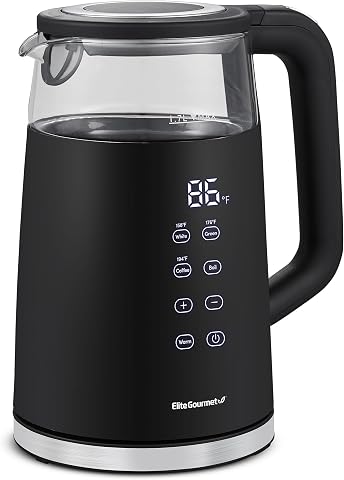
Elite Gourmet 1.7L Dual-Wall Cool-Touch Electric Kettle
- ✔ Capacity: 1.7 L
- ✔ Power: 1100 W
- ✔ Temperature settings: White tea, green tea, oolong/coffee, and boil presets

Amazon Basics 1-Liter Electric Kettle with Glass Carafe
- ✔ Capacity: 1 liter
- ✔ Power: 1500W
- ✔ Carafe: Glass
The real decision tension is simple: temperature accuracy itself has become cheap. Almost any $40 kettle can heat water to 175°F within a few degrees. What you pay extra for is precision at the margins — holding temperature for an hour instead of losing it, pouring in a controlled thin stream, faster heating, and materials that survive daily use for a decade. For casual tea drinkers, those extras are largely wasted money. For pour-over coffee brewers, the pour control alone can justify the price.
This guide compares the two categories side by side across the criteria that actually drive the purchase — accuracy, temperature hold, speed, pour control, capacity, build, and usability — and tells you plainly which kind of buyer each one suits.
At a Glance
| Criteria | Budget variable-temperature kettle ($30–60) | Premium precision kettle ($100–170) | Winner |
|---|---|---|---|
| Temperature accuracy and control granularity | Preset buttons (usually 4–6 temps), ±3–5°F accuracy, no custom degrees | Degree-by-degree adjustment (or precise dial), ±1–2°F accuracy | B |
| Temperature hold function | Often missing or short (some hold 60 min, many none) | Standard: 30–60 min hold with auto reheat cycles | B |
| Heating speed | Decent for small volumes; 1L can take 5–7 min | 1200–1500W elements; noticeably faster for full loads | B |
| Pour control | Standard spout; fast, splashy pour | Gooseneck spouts and counterbalanced handles on many models | B |
| Capacity and shape | Usually 1.0–1.7L, wide and tall | Often 0.8–1.0L; slimmer, counter-friendly | A |
| Build quality and durability | Mostly plastic-heavy; 1–3 year lifespan typical | Stainless/steel-and-glass construction; 3–5+ year lifespan | B |
| Ease of use and features | Simple buttons, sometimes cluttered labels | Cleaner interfaces, LCD displays, timers, sleep modes | Tie |
| Price and value | $30–60; core function per dollar is excellent | $100–170; paying 2–4x for refinement, not raw capability | A |
Chefman Electric Kettle with Temperature Control, 1.8 L
The Chefman stands out as the only kettle in this lineup designed to brew tea, not just heat water. Its removable stainless infuser lets you steep loose-leaf directly in the kettle at the correct preset temperature, which neither the Elite Gourmet nor the Amazon Basics can do. For green, white, or oolong drinkers who currently juggle a kettle and a separate steeping vessel, this consolidates two steps into one.With seven temperature presets spanning 160°F to 212°F, it offers the widest temperature range here, covering delicate greens through full boils for black tea and French-press coffee. The Elite Gourmet counters with adjustable fine-tuning and a live display, but the Chefman’s preset spread is broader, and its tri-color LED lights give an at-a-glance read on where the water is in the cycle. One caution: listing inconsistency in the product title versus the description leaves some ambiguity about the exact preset count, so verify before purchasing if a specific setting matters to you.Practically, the 1.8-liter capacity is the largest in this comparison, and the cordless carafe with 360-degree swivel base makes it easy to serve at a table in either direction. Compared with the Elite Gourmet’s cool-touch dual wall, the Chefman’s single-wall glass carafe runs hot to the touch — a real consideration around children. Automatic shutoff on boil and when empty rounds out a safety profile that matches the other two picks. This model makes the most sense for households that drink a variety of teas and want one appliance to handle the whole ritual.
Pros:
- Seven temperature presets covering 160–212°F for every major tea type
- Removable infuser lets you steep loose-leaf tea directly in the kettle
- Largest capacity of the group at 1.8 liters
- Cordless carafe with 360-degree swivel base for easy serving
Cons:
- Glass exterior gets hot during use, unlike dual-wall competitors
- No keep-warm function or real-time temperature display
- Listing inconsistency between five and seven presets creates confusion
Best for: Loose-leaf tea drinkers and households that brew multiple tea types throughout the day
Not ideal for: Anyone who needs an exact hold temperature or keep-warm function, or kitchens where a hot glass exterior is a safety concern
Bottom line: The most complete tea-focused package here — if you steep loose-leaf and value range over fine control, this is the one to buy.
“The most complete tea-focused package here — if you steep loose-leaf and value range over fine control, this is the one to buy.”
Elite Gourmet 1.7L Dual-Wall Cool-Touch Electric Kettle
Where the Chefman focuses on the brewing ritual, the Elite Gourmet focuses on control and comfort during long sessions. Its touchscreen offers dedicated presets for white tea, green tea, oolong/coffee, and boil, plus plus-and-minus adjustment for dialing in an exact target — a level of granularity the Chefman’s fixed presets cannot match. A real-time temperature display shows you exactly where the water is, removing the guesswork entirely.The feature that most justifies this pick is the two-hour keep-warm function. If you re-steep oolongs or pu-erhs multiple times, or simply sip slowly over a morning, the water stays ready instead of requiring a full reheat. Neither competitor offers anything comparable; with the Chefman, you reheat from scratch every time.The dual-wall cool-touch body is the other headline differentiator. The stainless #304 interior keeps water contact clean, while the outer wall stays safe to touch — a meaningful advantage over the Chefman’s hot glass for families with kids or busy counters. At 1100 watts, however, it is the least powerful heater here; the Amazon Basics boils faster with 1500 watts, though it heats its full 1.7 liters in under ten minutes, which is adequate for most routines. This model is better suited to patient, precision-minded brewers than to anyone prioritizing raw speed or in-kettle steeping.
Pros:
- Adjustable temperature with real-time display for exact control
- Keep-warm function holds temperature for up to 2 hours
- Cool-touch dual-wall body is safer around children
- Food-grade #304 stainless interior with BPA-free parts
Cons:
- 1100W heating element is the slowest of the three
- No infuser, so loose-leaf steeping requires a separate vessel
- Touchscreen controls may feel fussy compared with simple dials or buttons
Best for: Multi-steep tea drinkers and anyone who wants exact temperatures with a keep-warm hold
Not ideal for: Buyers who mainly need fast boiling, or anyone who dislikes touchscreen controls on appliances
Bottom line: The most precise and family-safe option in this lineup, trading heating speed for adjustability and a genuine keep-warm hold.
“The most precise and family-safe option in this lineup, trading heating speed for adjustability and a genuine keep-warm hold.”
Amazon Basics 1-Liter Electric Kettle with Glass Carafe
Let us be direct: the Amazon Basics kettle is included as the value option for buyers whose real need is fast, safe boiling, not true variable temperature control. Its Strix thermostat is a trusted, reliable component that governs automatic shutoff accurately — but it does not offer selectable presets like the Chefman or adjustable targets like the Elite Gourmet. If precise 175°F green-tea water is your priority, skip this one.What it does deliver is speed and simplicity. The 1500-watt element is the most powerful in this comparison, bringing its smaller one-liter load to a boil faster than either rival — a genuine advantage for single-cup pour-overs, instant noodles, or oatmeal. The wide 75-degree opening and removable filter make cleaning and descaling easier than on either competitor, which matters more than most buyers expect with hard water.Compared with the Chefman, it gives up 0.8 liters of capacity, the infuser, and all preset flexibility. Compared with the Elite Gourmet, it gives up keep-warm, the display, and the cool-touch body. In exchange, you get the lowest-complexity kettle here: fewer parts, fewer failure points, and BPA-free water-contact materials. This pick makes the most sense for students, office desks, travelers, and anyone whose hot-beverage routine begins and ends at boiling.
Pros:
- 1500W element boils its 1-liter load faster than either competitor
- Automatic shutoff and boil-dry protection with a reliable Strix thermostat
- BPA-free water-contact materials and a durable glass carafe
- Wide 75-degree opening and removable filter make cleaning easy
Cons:
- No selectable temperature presets — it is a boiling kettle, not a variable-temperature one
- 1-liter capacity is the smallest in this comparison
- No keep-warm function or temperature display
Best for: Students, offices, and solo drinkers who mostly need fast boiling in a small space
Not ideal for: Green or white tea drinkers who need sub-boiling water at specific temperatures
Bottom line: A dependable, quick boiler for boiling-based routines, but not a true temperature-control kettle — know what you are buying.
“A dependable, quick boiler for boiling-based routines, but not a true temperature-control kettle — know what you are buying.”
As an Amazon Associate we earn from qualifying purchases.
Key Differences
The most important structural difference is that budget kettles treat temperature control as a feature, while premium kettles treat it as the entire product. A $40 kettle gives you preset buttons — say 160°F, 175°F, 190°F, 205°F, and boil — and heats to within a few degrees of the target. That is genuinely sufficient for green tea, black tea, and French press coffee, where a five-degree swing barely registers in the cup. Premium kettles let you dial an exact temperature and, more importantly, hold it there: the Breville IQ and Fellow Stagg both maintain temperature for up to an hour with periodic reheating, so your second and third brews start at the right temperature without waiting.
The second big difference is pour control, and it matters for an asymmetric reason. If you brew tea with bags or infusers, or make drip coffee, pour control is irrelevant — you just dump water in. But if you do pour-over coffee (V60, Chemex) or gongfu-style tea, the slow spiral pour from a gooseneck spout is a technique requirement, not a luxury. Most premium kettles are goosenecks or have flow-restricted spouts; most budget kettles pour fast and hard. This single criterion decides the purchase for a large share of buyers.
Third, there is a durability and experience gap. Budget kettles lean on plastic lids, handles, and internal components; reviews commonly report failures within one to three years, particularly at the switch and lid. Premium kettles use all-stainless bodies, better seals, and replaceable-feeling construction, and they usually look better sitting on the counter. None of that makes your tea taste different — but it changes how long the purchase lasts and how much you enjoy using it.
Detailed Comparison
Budget kettles offer preset temperatures, typically four to six of them, with real-world accuracy of plus or minus 3 to 5 degrees Fahrenheit. Premium kettles allow single-degree adjustment via dial or up/down buttons and hold accuracy within 1 to 2 degrees. For tea, presets cover nearly every real need: green tea around 175°F, oolong around 195°F, black at boiling. The premium advantage shows up in specialty use — a pour-over recipe calling for exactly 202°F, or delicate Japanese greens that turn bitter at 180°F. The premium kettle wins, but for most drinkers the gap is smaller than the price gap suggests. Accuracy itself is not the reason to upgrade; granularity is a convenience, not a necessity.
This is an underrated differentiator. Many budget kettles heat to target and then let the water drift down immediately — by the time you brew a second pot, you are 15 degrees cooler and may need to reheat from scratch. Some budget models do include a 60-minute hold, so check specs carefully; it is the single most valuable feature hiding in the budget tier. Premium kettles almost universally hold temperature for 30 to 60 minutes with automatic reheat cycles. For households where people brew at staggered times, or for multi-infusion tea sessions, hold is genuinely useful and the premium tier delivers it more reliably. Winner: premium, by a moderate margin — but budget models with hold close most of this gap.
Both tiers typically use 1200W to 1500W elements, so small volumes heat in comparable time — two to three minutes for two cups. The differences appear with full loads: a premium 1500W kettle brings a liter to boil in roughly four minutes, while some budget 1.7L models take six to seven. If you heat full kettles for a family or for cooking (blanching, oatmeal, pasta starts), the extra minute or two adds up daily; for single-cup use, you will not notice. Premium wins on speed, but the gap is minor for typical solo brewing and moderate for full-kettle users.
This is the most decisive criterion — in one direction only. Budget kettles have standard wide spouts that dump water fast, which is fine for tea pots and French presses. Premium kettles, especially the Fellow Stagg EKG and its competitors, pair gooseneck spouts with counterbalanced handles for a slow, precise spiral pour. If you brew pour-over coffee, this is not a nice-to-have; extraction quality depends on controlled pour rate, and trying to do a 30-second spiral pour with a budget kettle is genuinely frustrating. If you never do pour-over, this entire advantage is worthless to you. Premium wins for pour-over brewers; for everyone else it is irrelevant.
Capacity and shape (Budget variable-temperature kettle ($30–60) wins — moderate)
Budget kettles usually win on raw capacity — 1.0 to 1.7 liters versus the 0.8 to 1.0 liters typical of premium goosenecks, which are deliberately compact for precision. A 1.7L budget kettle fills a teapot for four people or covers cooking tasks; a 0.9L gooseneck forces refills for guests. Families and multi-use kitchens should favor the budget tier on this alone. Singles and coffee brewers will find the smaller premium capacity perfectly matched to their workflow. Budget wins on capacity; whether that matters depends entirely on household size.
Budget kettles mix stainless bodies with plastic lids, handles, and buttons, and long-run owner reviews frequently mention switch failures, lid mechanism issues, or cloudy water from seals within one to three years. Premium kettles use all-stainless or steel-and-glass construction with better fit and finish, and typically last longer — Fellow and Breville units commonly run five years or more. That durability gap partially offsets the price difference: a $150 kettle lasting six years costs about the same per year as two $40 kettles replaced over the same period. Premium wins on build, and the gap is real, though it narrows the value math more than the sticker prices suggest.
Ease of use and features (minor difference)
Budget kettles range from cleanly designed to button-cluttered, with small labels and occasional confusing mode lights. Premium kettles offer single-dial interfaces, clear LCD readouts, brew timers (a hidden gem for pour-over), and sleep modes. Interestingly, some buyers find premium minimalism frustrating — Fellow’s single dial and one-button logic is elegant but has a learning curve. Both tiers are easy enough for daily use; this is a wash with personal-taste weighting. Tie.
Price and value (Budget variable-temperature kettle ($30–60) wins — major)
Budget kettles deliver roughly 90 percent of the core function — heating water to a chosen temperature — for 25 to 40 percent of the price. On pure function-per-dollar, budget wins decisively. Premium pricing buys refinement: hold functions, pour precision, durability, and design. Whether that refinement is worth triple the cost depends almost entirely on whether you brew pour-over coffee or care about counter aesthetics. For tea drinkers with standard habits, the extra spend is hard to defend. Budget wins on value for most buyers.
Budget variable-temperature kettle ($30–60): Pros and Cons
Pros:
- Core temperature control at a quarter of the price
- Larger capacity (up to 1.7L) suits families and cooking use
- Cheap to replace; low risk if your habits change
- Some models include 60-minute hold — check specs for this
Cons:
- Preset-only temperatures, no degree-level adjustment
- Many models lack a hold function entirely
- Fast, imprecise pour unsuitable for pour-over coffee
- Plastic components and shorter typical lifespan (1–3 years)
Pros:
- Single-degree temperature control with ±1–2°F accuracy
- Reliable 30–60 minute hold with auto reheat
- Gooseneck pour control essential for pour-over coffee
- All-stainless build, longer lifespan, better counter presence
- Brew timers and cleaner interfaces on many models
Cons:
- Two to four times the price for functions many drinkers never use
- Smaller capacity (often under 1L) inconvenient for groups
- Minimalist controls can have a learning curve
- Overkill for bagged tea and basic black tea drinkers
Who Should Choose What
Choose Budget variable-temperature kettle ($30–60) if:
- You brew bagged or loose-leaf tea with a standard pot or infuser and just need ‘not boiling’ water for greens and whites
- You want a kettle for mixed kitchen use — tea, oatmeal, blanching, French press — where capacity beats precision
- You are unsure whether temperature control matters to you and want to test the habit cheaply
- You are buying for an office, guest room, or dorm where loss or damage is likely
- You found a specific budget model with a 60-minute hold function — that closes most of the practical gap
Choose Premium precision kettle ($100–170) if:
- You brew pour-over coffee (V60, Chemex, Kalita) — the gooseneck pour is a technique requirement, not an upgrade
- You do gongfu-style or multi-infusion tea sessions where holding temperature for 30+ minutes matters
- You brew at exact recipe temperatures (e.g., 202°F light roasts) and want degree-level control
- You use the kettle multiple times daily and value build quality that lasts five-plus years
- The kettle lives on a visible counter and design consistency matters to you
Skip both if: You only drink black tea, instant coffee, or boiled water for cooking — a basic $20 kettle with a single boil setting does everything you need, and paying for temperature control of any tier is wasted money.
Value for Money
Value here splits cleanly by use case. For tea drinkers with conventional habits, the budget kettle is unambiguously the better value: it performs the entire job — heating water to a tea-appropriate temperature — for $30 to $60, and the premium kettle’s advantages (pour precision, degree granularity, design) do nothing for your cup. Paying $150 in this scenario buys counter aesthetics, not better tea.
The premium price becomes defensible in two situations. First, pour-over coffee: if you brew V60 or Chemex regularly, a gooseneck kettle is functionally required equipment, and the $100-plus models are the ones that pour well. Second, heavy daily use: if you brew four or more times a day, the hold function saves real time, and the longer lifespan means the per-year cost gap shrinks — a $150 kettle lasting six years roughly matches two budget replacements.
A reasonable middle path exists: several brands sell gooseneck kettles with variable temperature control in the $60 to $90 range. These sacrifice some finish and hold reliability but capture the pour control that drives most premium purchases. If your only premium motivation is pour-over, that middle tier may be the actual value sweet spot.
Final Verdict
For most buyers — meaning tea drinkers with normal habits — the budget variable-temperature kettle is the right call, and choosing it is not a compromise; it is the rational purchase. Preset temperatures at ±3–5°F accuracy cover green, white, oolong, and black tea completely, and the $100 you save buys a lot of good tea leaves.
Pay premium only when a specific requirement demands it. If you brew pour-over coffee, buy a premium gooseneck — this is the single biggest deciding factor in the entire comparison, and no budget kettle compensates for it. If you run long multi-infusion tea sessions or brew at exact recipe temperatures, the hold function and degree-level control also justify the upgrade.
The one refinement worth insisting on even at the budget level is a hold function, if you can find it. Beyond that, resist the upgrade pull: the premium tier refines the experience of temperature-controlled brewing, but for the majority of users, the budget tier already delivers its results.
Frequently Asked Questions
Are preset temperatures enough, or do I need degree-by-degree control?
For tea, presets are almost always enough — most tea categories have a 10–15 degree comfort range, so a preset landing within 5 degrees is fine. Degree-level control matters mainly for pour-over coffee recipes that specify exact temperatures (often 195–205°F) and for delicate teas where you want to fine-tune after tasting. If neither applies to you, presets are sufficient.
What is a temperature hold function and do I need it?
Hold keeps the water at your target temperature for 30–60 minutes by briefly reheating as it cools. It is valuable if people in your household brew at different times, or if you do multiple infusions of the same leaves. If you boil once, brew immediately, and walk away, you will never use it — but it is the most useful feature to look for even in a budget kettle.
Can I use a regular kettle and just let the water cool down instead?
You can — boiling water left standing drops roughly 5°F per minute in a typical kettle, so waiting 3–4 minutes approximates green tea temperature. It works, but it is inconsistent (depending on kettle material, room temperature, and volume) and adds friction to every brew. If you drink temperature-sensitive tea daily, a $40 variable-temperature kettle is one of the better cost-to-improvement ratios in kitchen equipment.
Is a gooseneck worth it if I only drink tea?
No. Gooseneck spouts exist for controlled pouring into small coffee brewers; a narrow stream actually makes filling a large teapot slower and more tedious. Tea drinkers should prefer a standard spout and larger capacity, which points squarely at the budget tier or a non-gooseneck premium model like the Breville IQ.
How long do budget temperature-control kettles typically last?
Most owner-reported failures occur between one and three years, usually at the power switch, lid mechanism, or internal seals. That is a real weakness versus premium models, which commonly run five years or more. Practically, two $40 kettles over six years cost about the same as one $150 kettle — so durability alone rarely justifies the premium price; buy premium for the features, not the longevity math.
Fall Picks
fall essentials
As an affiliate, we earn on qualifying purchases.