
In tea leaf reading, you interpret symbols like animals, objects, and shapes to gain insights into your future and present. Animals often symbolize traits or opportunities, while objects might represent specific themes or influences. Shapes and patterns reveal connections and underlying messages. To improve, observe the overall pattern, trust your intuition, and consider symbol placement. Keep exploring these symbols, and you’ll open deeper meanings that can guide your understanding as you continue to explore.
Key Takeaways
- Recognize common symbols like animals, objects, geometric shapes, and abstract forms in tea leaves.
- Understand that symbols’ meanings relate to different life areas, such as future events or personal traits.
- Focus on overall patterns and symbol placement within the cup (top, middle, bottom) for accurate interpretation.
- Develop intuition by recording readings, trusting impressions, and observing symbol interactions over time.
- Enrich your readings by considering cultural contexts and paying attention to feelings and impressions during analysis.

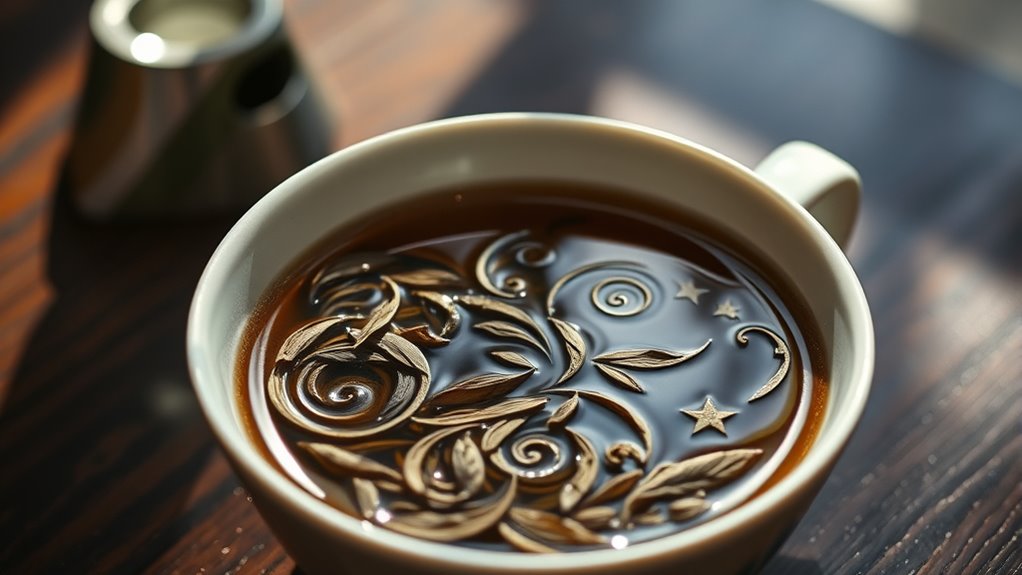
Tea leaf reading, also known as tasseography, is a fascinating practice that lets you glimpse into the future by interpreting the patterns left in a cup of tea. The key to revealing its secrets lies in recognizing the symbols and applying effective interpretive techniques. As you begin your journey, you’ll notice that certain shapes and images appear naturally in the tea leaves, each carrying specific meanings. These are your fortune-telling symbols, and learning how to identify them is essential. Common symbols include animals, objects, geometric shapes, and abstract forms, each representing different aspects of your life or future events.
Recognize symbols like animals and objects to uncover insights into your future through tea leaf reading.
Your interpretive techniques involve more than just recognizing symbols. They require intuition, focus, and context. When you examine the tea leaves, start by observing the overall pattern rather than zooming in on individual shapes. Look at the position of the symbols within the cup: the top usually indicates future events, the middle relates to present influences, and the bottom reflects past or underlying factors. As you develop your skills, you’ll learn to see connections between symbols and interpret their meanings based on their placement and relationships. For instance, a bird might symbolize freedom or new opportunities, while a snake could hint at caution or transformation.
To refine your interpretive techniques, keep a journal of your readings. Note the symbols you see and the interpretations you assign, then observe how accurate or relevant they turn out to be over time. This practice helps you trust your intuition and recognize patterns more easily. It’s also useful to familiarize yourself with traditional symbol meanings, but remember that personal intuition plays a significant role. Sometimes, a symbol might take on a unique significance based on your current life situation.
Additionally, understanding anime culture and storytelling can enrich your interpretation, as some symbols may be influenced by popular media or personal interests. As you practice, don’t rush to find perfect answers. Instead, focus on developing a dialogue with the symbols and trusting your instincts. Pay attention to your feelings and impressions during each reading—they often hold clues that deepen your understanding. Remember, tasseography is as much an art as it is a science. The more you practice, the more natural it becomes to interpret the intricate language of tea leaves. With patience and curiosity, you’ll begin to see how each symbol connects to your life story and future possibilities, making tea leaf reading a truly insightful and personal experience.
Frequently Asked Questions
Can Tea Leaf Reading Predict Specific Future Events?
You wonder if tea leaf reading can predict specific future events. While some believe it offers insights into potential outcomes, its predictive accuracy varies and isn’t guaranteed. You might see symbols that suggest certain possibilities, but it’s essential to remember that tea leaf reading provides guidance rather than precise predictions. Use it as a tool for reflection, understanding that future events remain uncertain and influenced by many factors.
How Accurate Is Tea Leaf Reading Compared to Other Methods?
They say, “Trust, but verify,” and that’s true for tea leaf reading. Its accuracy depends heavily on the reader’s expertise and the perceived statistical validity of the method. Compared to scientific tools, tea leaf reading isn’t as precise or consistent. It’s more of an intuitive art than a reliable prediction method. So, trust your intuition, but don’t rely solely on tea leaves for important decisions.
Do Personal Beliefs Affect the Reading’s Interpretation?
Your personal beliefs can definitely influence how you interpret tea leaf readings. Personal bias and cultural influence shape your perceptions, making some symbols seem more significant than others. This means your background and mindset might color the reading’s accuracy, as you may focus on certain details that align with your beliefs. To get a clearer reading, try to set aside biases and remain open-minded, allowing the symbols to speak more objectively.
Is Tea Leaf Reading Suitable for Beginners Without Any Training?
You might wonder if tea leaf reading is suitable for beginners without training. While it offers beginner accessibility and encourages intuitive learning, it can be tricky without guidance. With some basic instruction, you’ll start recognizing symbols and patterns, making the process more enjoyable. Keep an open mind and practice regularly; over time, your intuition will sharpen, making tea leaf reading a rewarding and accessible activity even for newcomers.
Are There Cultural Differences in Tea Leaf Symbolism?
You might think symbols are universal, but cultural variations in tea leaf symbolism are like comparing night and day. You’ll find that symbolic differences across cultures are vast, influencing how you interpret shapes and images. These differences can seem mind-blowing, making it essential to understand cultural context. So, when you explore tea leaf reading, remember that symbols don’t always mean the same thing everywhere, adding richness and complexity to your practice.
Conclusion
Now that you know the symbols and their meanings, you’ll gain confidence in interpreting tea leaves. Remember, nearly 60% of tea readers say intuition plays a significant role alongside symbols. So, trust your instincts and keep practicing. With time, you’ll develop a keen eye for patterns and insights. Tea leaf reading isn’t just about symbols—it’s about connecting with your intuition and the stories the leaves tell. Happy reading!