
TL;DR
Open a free Amazon Business account
Business pricing, bulk buying and tax-exempt orders.
Create a free accountAs an affiliate, we earn on qualifying purchases.
Building your own AI workstation used to save money, but today prebuilt systems often match or beat DIY prices thanks to component shortages and bulk buying. Your choice hinges on whether you want quick setup and validated performance or full control and customization.
Imagine this: you need a powerful AI workstation. You’re torn between building it yourself or buying a prebuilt. The landscape isn’t what it used to be. For years, DIY was the obvious choice for saving money, while prebuilts promised quick setup. But now? The rules have changed. Component shortages and soaring prices have made DIY more expensive, not cheaper, in many cases. Meanwhile, top-tier prebuilt systems pack in validated thermals, expert tuning, and warranty support. This article cuts through the hype to help you decide which path really offers the best value for your workload and budget. For more insights, see the culinary tips and kitchen guides.
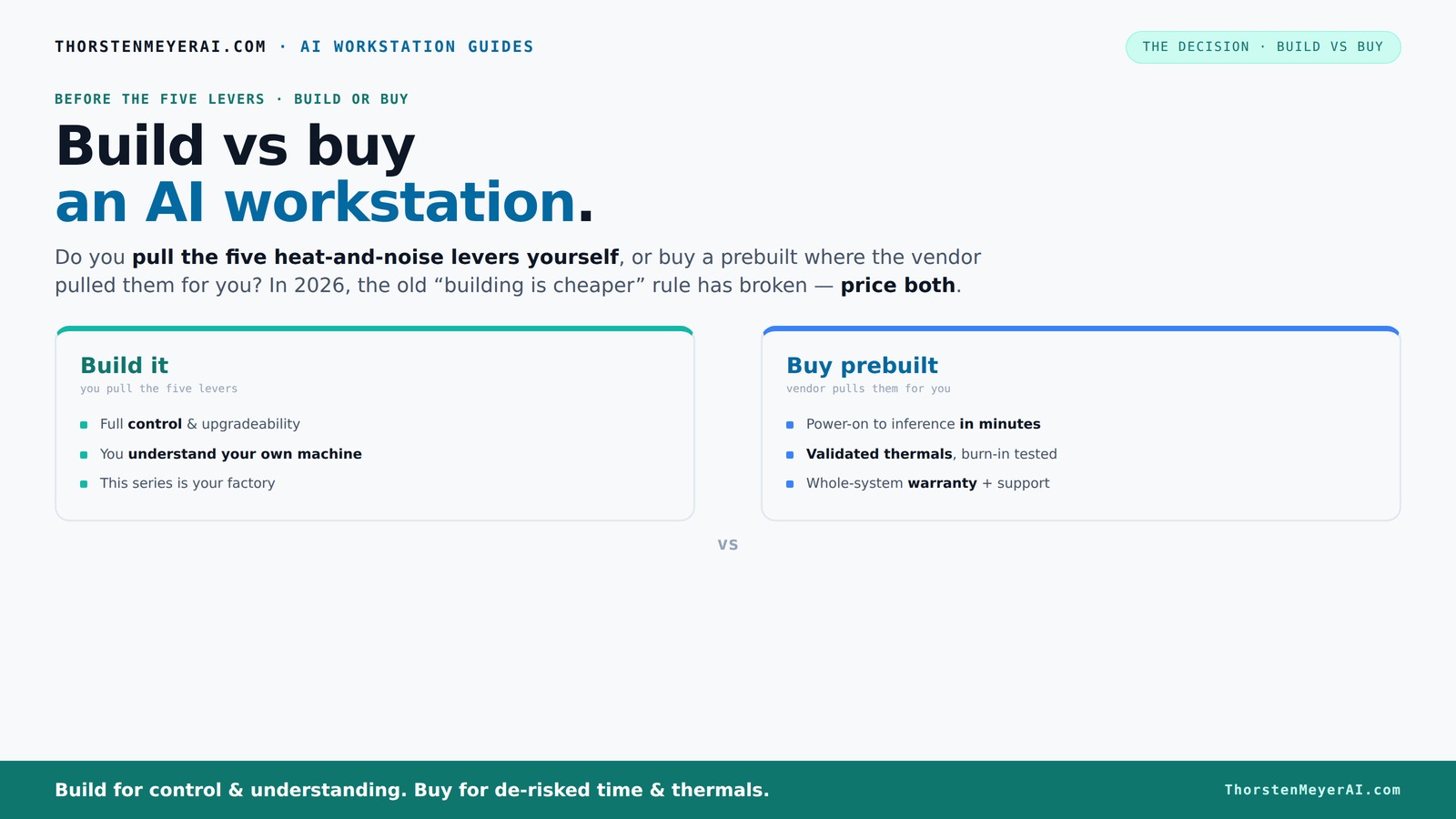
Build vs buy
an AI workstation.
The real question behind this whole series: do you pull the five heat-and-noise levers yourself, or buy a prebuilt where the vendor pulled them for you? And in 2026, the old “building is cheaper” rule has broken. Match your situation in Part 3.
Key Takeaways
- Component shortages and price spikes mean prebuilts can often match or beat DIY costs in 2026.
- Prebuilts save time, come with validated thermals, and include support — ideal for quick deployment and reliability.
- DIY offers control, customization, and potential long-term upgrade advantages, but requires time, expertise, and patience.
- The heat and noise tuning process is managed by the vendor in prebuilts, or by you in DIY setups — each has trade-offs.
- Your choice depends on workload, technical skill, time budget, and whether you prioritize speed or control.
As an affiliate, we earn on qualifying purchases.
Why Building Your Own AI Workstation Is Still a Challenge in 2026
Building your own AI rig isn’t just about picking parts anymore. You might want to consider whether to build vs buy a prebuilt AI workstation. It’s a complex puzzle involving sourcing high-demand components like GPUs, DDR5 RAM, and SSDs. Prices have surged due to global shortages, which means that the cost difference between DIY and prebuilt systems has narrowed or even reversed. If you're curious about the latest hardware options, check out build vs buy a prebuilt AI workstation. This matters because it forces you to reconsider whether the time and effort spent on sourcing and assembling are justified when the financial advantage has diminished. Moreover, the process of selecting compatible parts, ensuring thermal stability, and optimizing airflow is intricate. It requires a deep understanding of hardware interactions, thermal dynamics, and system tuning. Failing to do so can lead to thermal throttling, noise issues, or even hardware failure, which could negate any perceived cost savings. The tradeoff here is between potential customization and the risk of inefficiency or delays. For more on thermal management, see commercial kitchen equipment and solutions. For many, the increased complexity and potential for costly mistakes make DIY less appealing unless they have specific needs or expertise. Additionally, the current market volatility means that even experienced builders might face delays or inflated prices, eroding the traditional advantage of DIY building as a cost-effective solution.
The Five Levers of Heat and Noise — Who Controls Them?
Running a high-powered AI workstation cool and quiet is a game of five levers: undervolting GPUs, matching coolers, optimizing airflow, tuning fans, and careful placement.
Buy a prebuilt and the vendor pulls these levers. They validate thermals, tune fan curves, and often install water-cooling — making the system run cooler and quieter straight out of the box. This controlled tuning is critical because thermal management directly impacts performance and longevity. Poor thermal control can cause thermal throttling, reducing GPU and CPU performance, and can accelerate hardware degradation. Vendors invest in thermal testing and tuning to balance performance, noise, and component lifespan, which is especially important in dense multi-GPU setups where heat buildup is a significant concern. This means that for many users, a prebuilt provides a reliable thermal environment without the need for technical expertise, ensuring consistent performance and reduced maintenance worries. However, this also means you are dependent on the vendor’s design choices and thermal solutions, which may not be perfectly tailored to your specific workload or environment. The implication is that prebuilt systems often optimize for balance and reliability, potentially sacrificing some degree of customization but gaining stability and peace of mind.
Build it yourself? You control every lever. Choosing a quiet GPU, undervolting it, selecting a low-noise cooler, and designing airflow takes effort but allows perfect tuning. You learn and gain mastery over your machine’s thermal personality. This control can lead to a quieter, more efficient system tailored precisely to your needs, but it requires ongoing maintenance, testing, and a good understanding of thermal dynamics. Learn more about system tuning at build vs buy a prebuilt AI workstation. The tradeoff is that improper tuning may result in overheating, noise, or reduced hardware lifespan. Therefore, the decision hinges on whether you value hands-on control and are willing to invest the time to learn and maintain your system’s thermal profile versus relying on professional validation and tuning provided by prebuilt vendors.
Evaluating Your Priorities: A Decision Framework
Before choosing between building and buying, consider a simple decision framework. Ask yourself:
- How urgent is my need for the system? Do I need it ready in days or weeks?
- What is my technical skill level? Am I comfortable troubleshooting hardware issues?
- What is my budget, including potential delays or hidden costs?
- Am I seeking maximum customization and control or reliability and support?
Based on your answers, you can match your priorities to the options:
- If you need quick deployment, prefer validated thermals, and want support, a prebuilt is likely your best choice.
- If you have the skills, time, and desire for customization, building your own system might be more satisfying and cost-effective in the long run.
Remember, your decision should align with your workload demands and personal or organizational capacity for maintenance and troubleshooting. For more technical guidance, visit build vs buy a prebuilt AI workstation. Use this framework to make a strategic choice that saves time, reduces stress, and maximizes value.
Frequently Asked Questions
Is a prebuilt AI workstation more expensive than building one yourself?
Not always. Due to component shortages and bulk discounts, prebuilts can now match or even beat DIY costs, especially for high-end configurations. Always price both options for your specific needs.Will a prebuilt perform as well as a custom build for AI training or inference?
Yes, reputable vendors validate thermals and optimize cooling, often providing systems that perform on par or better than DIY setups, especially under sustained loads. This validation reduces the risk of thermal throttling and hardware failure, which are common pitfalls in DIY builds if not carefully managed.Which is better for local LLMs, image generation, or video AI workloads?
Prebuilts are generally ideal for these workloads because they come with validated multi-GPU setups and thermal management, reducing troubleshooting time. Their optimized configurations ensure stability during prolonged, intensive tasks, which is crucial for professional or research environments.How much VRAM, RAM, and storage do I need?
It depends on your workload. For LLM training, aim for at least 24GB VRAM on GPUs to handle large models without bottlenecks. 128GB RAM is recommended for complex models and multitasking. Fast SSDs, preferably NVMe, are essential for quick data access and reduced training times. Choosing the right balance ensures your system can handle current and future AI tasks effectively.Are prebuilt workstations easier to upgrade later?
Typically yes, but it varies. Many prebuilts use proprietary parts or custom layouts, which can limit future upgrades or component swaps. DIY systems, on the other hand, are designed for transparency and flexibility, making upgrades straightforward. This flexibility can extend the lifespan of your investment, especially as AI hardware continues to evolve rapidly.Conclusion
Building or buying your AI workstation isn’t just a budget decision anymore — it’s about how much control you want and how quickly you need to start. The market has shifted, and prebuilts now often match DIY prices thanks to supply chain chaos. Think about your workload, your skills, and your patience. Choose what aligns best, and get to work.
In the end, whether you build or buy, your AI journey begins with one step. Make it smart, and don’t forget — the right machine can change everything.
College move-in / dorm season Picks
dorm essentials
As an affiliate, we earn on qualifying purchases.