Cold brew coffee makers range from simple mason jar setups to dispenser-style brewers with spigots, and the right one depends on how much you drink, how much counter space you have, and how much fuss you’ll tolerate at cleanup time. After comparing 15 popular models, the OXO Good Grips Cold Brew Coffee Maker stands out as my best overall pick thanks to its Rainmaker top that distributes water evenly over the grounds and a brew-release switch that makes draining clean and mess-free. The Takeya Deluxe 2 Quart is the better choice if you want a shatter-proof, dishwasher-safe pitcher that travels well, while the 1 Gallon Spigot Model makes the most sense for households that go through cold brew by the pitcher. The main tradeoff you’ll face in this category is glass versus plastic, followed closely by filtration quality — cheap mesh baskets let sediment slip through, which ruins an otherwise smooth batch. Read on for the full breakdown of all 15 models and who each one suits best.

Get coffee and tea gear delivered free with Prime
- Fast, free delivery on millions of items
- Prime Video, Amazon Music and more included
- Member-only deals all year
Complete the kit


Key Takeaways
- Brew-release and drainage design separated the top picks from the rest: the OXO‘s switch-based system and the gallon model’s spigot eliminate the messiest step, while basic mason jar brewers require lifting a heavy, dripping filter basket by hand.
- The mason jar category is heavily commoditized — several 64oz models on this list are nearly identical, so lid quality, handle design, and filter micron rating are the only meaningful differentiators worth paying attention to.
- Tritan plastic pitchers (Takeya, Maestri House) won for durability and portability, but glass wins for long fridge storage since it never absorbs odors or stains from coffee oils.
- Capacity should match actual consumption: a 1-quart Takeya suits a solo drinker, while 64oz is the sweet spot for two people, and 1-gallon dispensers only pay off for serious daily drinkers or entertaining.
- Several budget models cut corners on the mesh filter, and a fine 100μm stainless filter — like the one in the 2 Pack model — noticeably reduces sediment compared with standard coarse mesh baskets.




| cold brew coffee maker | Capacity | Material | Filter |
|---|---|---|---|
| Bodum 51oz Cold Brew Coffee Ma | 51 oz | Stainless steel, rubber, silicone, BPA-free plastic | Reusable (no paper filters) |
| Cold Brew Coffee Maker | 1 gallon | Soda-lime glass, 304 stainless steel | Reusable stainless steel |
| OXO Good Grips Cold Brew Coffe | 32 oz concentrate (up to 14 drinks) | Borosilicate glass, stainless steel | Reusable stainless steel mesh |
| Primula Burke Deluxe Cold Brew | 6 cups (52 oz) | Glass carafe, BPA-free plastic | Removable mesh, reusable |
| Cold Brew Coffee Maker | 64 oz | Heavy-duty glass, stainless steel filter | 160-micron woven metal mesh |
| 64 oz Cold Brew Coffee Maker w | 64 oz | Food-grade soda-lime glass | — |
| Cold Brew Coffee Maker | 64 oz | Food-grade soda lime glass, stainless steel filter, BPA-free plastic lid | — |
| County Line Kitchen 64oz Cold | 64 oz | Glass, stainless steel, BPA-free plastic | Stainless steel mesh |
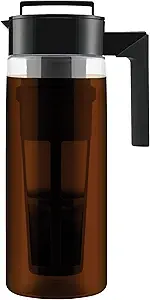
| Takeya Deluxe Cold Brew Coffee | 1 Quart | BPA-Free Tritan | Fine-mesh stainless steel |
| Takeya Deluxe Cold Brew Coffee | 2 Quart | BPA-Free Tritan | Fine-mesh stainless steel |
| County Line Kitchen 64oz Cold | 64 oz | Glass mason jar | Stainless steel mesh |
| Maestri House Cold Brew Coffee | 40oz (1.2 liters) | BPA-Free Tritan | — |
| 64 oz Cold Brew Coffee Maker M | 64 oz | Food-grade BPA-free plastic and stainless steel | 316L stainless steel, 160-micron dutch weave |
| 2 Pack Cold Brew Coffee Maker | 64 oz each | Heavy-duty glass, stainless steel filter | — |
| JunVpic Cold Brew Coffee Maker | 64 oz | Food-grade soda-lime glass | — |
More Details on Our Top Picks
Bodum 51oz Cold Brew Coffee Maker, Black
Most cold brew setups force a choice between capacity and counter space, but Bodum’s 51oz brewer splits the difference neatly. Its locking lid system is the real differentiator — unlike the OXO Good Grips, which relies on a separate brew container you pour from, this one seals tight so you can flip or shake it without drips. The all-stainless and silicone build also skips the fragile glass of the Primula Burke, making it a smarter pick for anyone worried about a cracked carafe. The tradeoff is capacity: at 51 oz it holds less than the 64oz mason jar pitcher, so heavy daily drinkers will refill more often. There’s also no spigot or concentrate-measuring system, which keeps things simple but limits precision.
Pros:- Locking lid system prevents spills and keeps coffee fresh
- No paper filters or capsules needed for an eco-friendly brew
- Stainless steel construction is more durable than glass alternatives
- Compact footprint fits easily in a fridge
Cons:- Smaller capacity than one-gallon or 64oz competitors
- Entirely manual brewing with no strength-control features
- Limited color and style options
Best for: Apartment dwellers and solo drinkers who want a durable, spill-proof brewer that survives a crowded fridge
Not ideal for: Households or entertainers who go through large batches — the 51 oz capacity means brewing more often
- Capacity:51 oz
- Material:Stainless steel, rubber, silicone, BPA-free plastic
- Color:Black
- Filter:Reusable (no paper filters)
- Lid:Innovative locking system, two lids included
- Operation:Manual
Our verdict“This is the pick for buyers who value durability and spill protection over raw capacity.”
Cold Brew Coffee Maker, 1 Gallon with Stainless Steel Filter and Spigot
If you’re serving a crowd, one gallon of cold brew changes the math entirely. This brewer doubles the output of the 64oz mason jar pitcher and quadruples the Bodum, and its stainless steel spigot means nobody has to lift a heavy, full pitcher to pour — a genuine advantage over every lift-and-pour model in this lineup. The 4-6 hour brew time is also unusually fast; the OXO asks for 12-24 hours, so this is the one to grab when guests arrive tonight. The compromises are real, though: soda-lime glass is less shock-resistant than borosilicate, and at 10.5 inches tall with a 4.4-pound build, it demands serious fridge shelf space.
Pros:- Fast 4-6 hour brew time beats overnight-steep competitors
- Spigot allows serving without lifting a heavy pitcher
- Versatile for iced tea and infused drinks, not just coffee
- Includes cleaning brush and accessories
Cons:- Soda-lime glass is fragile if knocked or dropped
- Large footprint dominates fridge shelf space
- No automated features despite the bigger price of admission
Best for: Hosts, offices, and multi-coffee households that need big batches on short notice
Not ideal for: Solo drinkers or small kitchens — a gallon of coffee is overkill and the footprint is large
- Capacity:1 gallon
- Material:Soda-lime glass, 304 stainless steel
- Dimensions:5.5″D x 5.5″W x 10.5″H
- Weight:4.4 pounds
- Brewing Time:4-6 hours
- Filter:Reusable stainless steel
- Features:Adjustable brew strength, spigot, permanent filter
- Operation:Manual
Our verdict“Buy this if you brew in volume; skip it if a single pitcher lasts you a week.”
OXO Good Grips Cold Brew Coffee Maker, 32 oz
The OXO Good Grips earns the top spot because it solves the problem most budget brewers ignore: consistent extraction. Its even-extraction system showers water over the grounds rather than just steeping them, which produces a noticeably more balanced concentrate than the Primula Burke’s simple basket soak. The borosilicate glass carafe is also more thermal-shock resistant than the soda-lime glass on the one-gallon spigot model, and the resulting concentrate stretches to roughly 14 drinks — impressive from just 32 oz. The price of that precision is patience: plan on 12-24 hours of steeping, and treat the carafe gently since a drop will end its career.
Pros:- Even-extraction system produces more consistent flavor than basket-steep designs
- Concentrate yields up to 14 servings from one brew
- Borosilicate glass withstands temperature changes better than standard glass
- Reusable mesh filter is dishwasher safe
Cons:- 12-24 hour brew time is slower than spigot models
- Fragile carafe requires careful handling
- 32 oz capacity means more frequent brewing for heavy drinkers
Best for: Coffee enthusiasts who want barista-quality concentrate and don’t mind planning a day ahead
Not ideal for: Impatient brewers or clumsy households — overnight steeping and glass construction both punish haste
- Capacity:32 oz concentrate (up to 14 drinks)
- Material:Borosilicate glass, stainless steel
- Brewing Time:12-24 hours
- Filter:Reusable stainless steel mesh
- Extraction:Even-extraction shower system
- Cleanup:Dishwasher-safe filter
Our verdict“The most refined brew in the lineup — worth it for flavor-focused buyers who brew deliberately.”
Primula Burke Deluxe Cold Brew Iced Coffee Maker, 6-Cup, Aqua
For a first foray into cold brew, the Primula Burke keeps things refreshingly simple: add grounds, add water, wait overnight. There’s no brew-switch mechanism like the OXO’s or spigot hardware like the one-gallon model — just a removable mesh filter that lifts out for cleanup, and everything is dishwasher safe, which the Bodum can’t claim. The 52 oz carafe holds more than the OXO’s 32 oz while costing meaningfully less, and the slim build fits most refrigerator doors instead of hogging a shelf. Just know what you’re getting: without an even-extraction system, expect slightly less nuance than the OXO, and a coarse grind is mandatory or you’ll fight sediment.
Pros:- Simple, beginner-friendly design with no learning curve
- Larger 6-cup capacity than the OXO at a lower price point
- Fully dishwasher safe including the removable filter
- Slim profile fits most refrigerator doors
Cons:- Overnight steeping required for best flavor
- Requires coarse-ground coffee to avoid sediment
- Glass carafe is breakable with rough handling
Best for: First-time cold brewers who want a low-cost, low-effort entry point that cleans up in the dishwasher
Not ideal for: Flavor perfectionists — the basic steep design can’t match the OXO’s extraction consistency
- Capacity:6 cups (52 oz)
- Material:Glass carafe, BPA-free plastic
- Color:Aqua
- Filter:Removable mesh, reusable
- Dishwasher Safe:Yes
- Fridge Fit:Fits most refrigerator doors
- Brew Type:Cold brew only
Our verdict“The easiest, cheapest way to find out if cold brew is your thing without a big commitment.”
Cold Brew Coffee Maker, 64oz Mason Jar Pitcher with Stainless Steel Filter
This 64oz mason jar pitcher targets the daily-drinker sweet spot between the Primula’s 52 oz and the commitment of a full gallon. Its standout feature is the 160-micron woven mesh filter — finer than the typical mesh baskets in similar mason jar brewers, which means noticeably less sludge in the glass. The leak-proof lid with pour spout and non-slip silicone base add daily-use practicality the Bodum lacks, and it’s dishwasher safe end to end. The limitations are temperature-related: unlike borosilicate models such as the OXO, this jar can’t handle boiling water or sudden temperature swings, so it’s strictly a cold-and-cool vessel.
Pros:- 160-micron woven mesh filter is finer than typical mason jar screens
- Leak-proof lid with pour spout enables mess-free fridge pouring
- Silicone base prevents slips and protects surfaces
- Dishwasher safe and doubles for tea or lemonade
Cons:- Cannot withstand boiling water or rapid temperature changes
- Heavy glass build is heavier and more fragile than Tritan pitchers like the Takeya
Best for: Daily iced-coffee drinkers who brew a few days’ supply at a time and want smooth, sediment-free results
Not ideal for: Anyone wanting hot brewing versatility — the glass can’t take boiling water or thermal shock
- Capacity:64 oz
- Material:Heavy-duty glass, stainless steel filter
- Filter:160-micron woven metal mesh
- Lid:Sealed, leak-proof with pour spout
- Base:Non-slip silicone
- Max Temperature:60°C (140°F)
- Cleanup:Dishwasher safe
Our verdict“The best fit for habitual cold brew drinkers who want batch capacity without gallon-scale overkill.”
64 oz Cold Brew Coffee Maker with Mason Jar Design and Stainless Steel Filter
What separates this mason jar brewer from the crowded 64 oz glass field is its 100-micron stainless steel filter, which is noticeably finer than the 160-micron mesh on the similar B0CGWS1M51 pitcher. That tighter weave translates into less sediment in the glass, which matters if you dislike the gritty finish common to budget cold brew. The flip-top spout is a genuine convenience over the screw-off lids on County Line Kitchen’s model, letting you pour without unscrewing anything. The included cleaning brush is a small touch, but it addresses the one chore everyone complains about with mesh filters. The tradeoff: fine mesh clogs faster, and the soda-lime glass demands careful handling. Still, for smoothness per dollar, this option leads the glass jar pack.
Pros:- Finer 100-micron filter than most mason jar rivals means smoother brew
- Flip-top spout allows spill-free pouring without removing the lid
- Dishwasher-safe with an included brush for filter maintenance
- Airtight silicone seal keeps batches fresh through a week of storage
Cons:- Soda-lime glass is fragile compared with Tritan alternatives
- Finer mesh requires more frequent scrubbing to prevent clogs
Best for: Cold brew drinkers who hate sediment in their cup and want a full half-gallon batch with convenient pour-and-serve design
Not ideal for: Households with kids or clumsy dishwashers — the glass jar will not survive a drop the way Takeya’s Tritan pitchers will
- Capacity:64 oz
- Material:Food-grade soda-lime glass
- Filter Material:304 stainless steel
- Filter Size:100 microns
- Lid Seal:Airtight BPA-free silicone
- Dishwasher Safe:Yes
- Included Accessories:Cleaning brush
Our verdict“Choose this if sediment-free smoothness is your priority and you’re willing to handle glass carefully.”
Cold Brew Coffee Maker, 64 oz Mason Jar Pitcher with Stainless Steel Filter, Pour Spout Handle Lid, Airtight & Leak-Proof for Iced Coffee, Tea & Lemonade
This pitcher earns its spot by being more than a coffee maker. While the B0BWMNPJKH jar is a dedicated brewer, this one doubles as an everyday pitcher for lemonade and iced tea, thanks to its ergonomic handle and spout lid that make one-handed pouring comfortable even when full. Its 160-micron filter is coarser than B0BWMNPJKH’s 100-micron mesh, so expect slightly more fines in the cup — the price of faster drainage and easier rinsing. The 60°C temperature limit is the real constraint: no hot brewing, and no rinsing with warm water straight from a cold fridge, or the glass can crack. Compared with the County Line Kitchen jar, the handle gives it a clear edge for daily serving duty.
Pros:- Ergonomic handle makes full 64 oz pouring manageable one-handed
- Airtight spout lid contains spills and locks in freshness
- Coarser mesh drains faster and rinses out more easily than finer filters
- Versatile enough to serve as a general-purpose beverage pitcher
Cons:- 160-micron filter lets more sediment through than finer competitors
- Temperature-sensitive glass cracks if exposed to warm liquids or sudden shifts
Best for: Buyers who want one pitcher that handles cold brew, iced tea, and lemonade with comfortable everyday pouring
Not ideal for: Anyone wanting hot or warm brewing — the 140°F temperature ceiling rules out dual-purpose hot use, which the 2-quart Takeya handles
- Capacity:64 oz
- Material:Food-grade soda lime glass, stainless steel filter, BPA-free plastic lid
- Filter Mesh Size:160 micron
- Lid:Airtight, leak-proof pour spout with handle
- Maximum Temperature:60°C (140°F)
- Dishwasher Safe:Yes
Our verdict“Pick this if you brew coffee but also want a do-everything pitcher; skip it if hot drinks are ever on the menu.”
County Line Kitchen 64oz Cold Brew Coffee Maker with Leak Proof Lid – Gray
County Line Kitchen’s gray mason jar brewer is the no-frills workhorse of this lineup. It lacks the finer 100-micron mesh of B0BWMNPJKH and the handled lid of B0CGWS1M51, but it delivers the essentials — a leak-proof flip-cap, dishwasher-safe parts, and a proven mason jar format — at the accessible end of the price spectrum. That flip-cap is its best feature: unlike screw-lid jars, you can pour mid-brew or mid-week without breaking the airtight seal entirely. As with the other glass jars here, it’s strictly a cold vessel — no warm or boiling water, ever. Compared with the Black version elsewhere in this roundup, the only difference is color, so pick whichever matches your kitchen and don’t overthink it.
Pros:- Straightforward design with almost nothing to break or confuse
- Leak-proof flip-cap enables convenient pouring without full unscrewing
- Dishwasher-safe components make cleanup quick
- Handles cold brew, iced tea, and travel use equally well
Cons:- Standard mesh filter lets more fines through than finer-filter rivals
- Cold-liquids-only glass rules out hot brewing or warm rinsing
Best for: First-time cold brewers and budget-conscious buyers who want a proven, simple design without paying for extras
Not ideal for: Sediment-sensitive drinkers or anyone wanting hot-brew versatility — the standard mesh and cold-only glass have firm limits
- Capacity:64 oz
- Material:Glass, stainless steel, BPA-free plastic
- Color:Gray
- Lid:Leak-proof flip-cap
- Filter:Stainless steel mesh
- Dishwasher Safe:Yes
Our verdict“This is the sensible starter pick if you want reliable cold brew with zero fuss and minimal spend.”
Takeya Deluxe Cold Brew Coffee Maker – BPA-Free Tritan Pitcher with Airtight Leakproof Lid, Silicone Grip Handle, Fine-Mesh Filter – Shatter-Proof, Dishwasher Safe, Made in USA – 1 Quart/Black
While the glass mason jars in this lineup dominate the counter, the 1-quart Takeya Deluxe is built for people who brew for one. Its shatter-proof Tritan body is the defining advantage over every glass option here — it survives drops, crowded fridges, and camping trips that would end a mason jar. The silicone grip handle out-pours anything in the glass camp, especially with wet hands. The obvious cost is capacity: at 1 quart, you’ll be brewing every few days instead of weekly, where a 64 oz jar or the 2-quart Takeya would carry you through. The fine-mesh filter does respectable sediment control, and it slips into a fridge door where half-gallon jars simply won’t fit. If countertop and shelf space drive your decisions, this is the one.
Pros:- Shatter-proof Tritan survives drops and travel that would crack any glass jar
- Slim 1-quart profile fits refrigerator doors and tight shelves
- Silicone grip handle offers the most secure pour in this lineup
- Made in the USA with a genuinely airtight, leakproof lid
Cons:- 1-quart capacity demands frequent rebrewing for all but solo drinkers
- Plastic body absorbs coffee oils and can retain odors over time unlike glass
Best for: Solo drinkers, small-fridge apartments, and travelers who need a durable brewer that fits anywhere
Not ideal for: Households of two or more — 1 quart disappears fast and frequent rebrewing becomes a chore
- Capacity:1 Quart
- Material:BPA-Free Tritan
- Lid:Airtight, leakproof
- Handle:Silicone grip
- Filter:Fine-mesh stainless steel
- Dishwasher Safe:Yes
- Made in:USA
Our verdict“Buy this if you brew for one and value durability and fridge-door fit over batch size.”
Takeya Deluxe Cold Brew Coffee Maker – 2 Quart, BPA-Free Tritan Pitcher with Airtight Leakproof Lid, Fine-Mesh Filter, Dishwasher Safe, Made in USA
The 2-quart Takeya Deluxe takes everything that makes the 1-quart version excellent and scales it to household size. You keep the shatter-proof Tritan construction — a decisive advantage over the fragile 64 oz glass mason jars from County Line Kitchen and B0BWMNPJKH — while gaining a batch that lasts most families a full week. Uniquely in this batch, it’s also rated for hot brewing, meaning loose-leaf tea or hot steeping are fair game, something the temperature-limited glass jars can’t touch. The slim footprint still fits most refrigerator doors, unlike the bulkier gallon brewers elsewhere in this roundup. Tradeoffs remain: Tritan can hold onto coffee oils and odors over months of use, and the fine mesh needs more manual attention than a quick rinse. For durability plus capacity, it’s the strongest all-rounder of this group.
Pros:- 2-quart capacity supports a full week of coffee for two or more drinkers
- Hot and cold brewing versatility unmatched by any glass jar here
- Shatter-proof Tritan construction survives drops and rough handling
- Slim design fits most refrigerator doors despite the larger volume
Cons:- Tritan can retain coffee oils and odors with long-term use
- Fine-mesh filter needs manual scrubbing rather than a quick rinse
Best for: Families and multi-drinker households who want week-long batches, hot/cold versatility, and a brewer that can’t shatter
Not ideal for: Devoted glass purists who worry about plastic odor retention, or very tight kitchens where even a 2-quart pitcher is a squeeze
- Capacity:2 Quart
- Material:BPA-Free Tritan
- Lid:Airtight, leakproof
- Filter:Fine-mesh stainless steel
- Brewing:Hot or cold
- Dishwasher Safe:Yes
- Made in:USA
Our verdict“This makes the most sense for households that want big, durable, dual-purpose brewing without any glass-breakage anxiety.”
County Line Kitchen 64oz Cold Brew Coffee Maker with Leak Proof Lid – Black
This option stands out for its built-in handle and leak-proof lid, which make it the most road-ready pick in this batch. Compared with the Maestri House Tritan pitcher, the glass mason jar gives brewing a more neutral, plastic-free flavor profile, though it sacrifices the shatter resistance that makes Tritan better for clumsy households. The stainless steel mesh filter keeps sediment out of the pour, and dishwasher-safe parts cut cleanup to a rinse-and-load affair. It also handles iced tea and infused water, so it earns its place in a cabin or campsite kitchen rather than living parked on one countertop. The tradeoff is weight and fragility: at 4 pounds and made of glass, it demands more careful packing than a plastic rival.
Pros:- Leak-proof lid makes it safe to pack in a cooler or car trunk
- Built-in handle for genuine portability
- Versatile beyond coffee — works for iced tea and other beverages
- Dishwasher-safe parts simplify cleanup after a trip
Cons:- Glass jar is fragile if mishandled in transit
- Not suitable for hot water or boiling liquids
Best for: Campers, RV travelers, and anyone who needs a portable brewer that seals tightly for transport
Not ideal for: Households worried about breakage — the glass jar will not survive a drop the way a Takeya Tritan pitcher would
- Capacity:64 oz
- Material:Glass mason jar
- Filter:Stainless steel mesh
- Dimensions:6″D x 6″W x 11″H
- Weight:4 pounds
- Operation Mode:Manual
- Recommended Uses:Cold brew coffee, iced tea, camping, traveling
Our verdict“This is the pick for brewers who take their coffee on the road and need a jar that seals, pours, and travels without drama.”
Maestri House Cold Brew Coffee Maker, 40oz BPA-Free Tritan Pitcher
What separates this model from the mason jar crowd is its BPA-free Tritan construction, which means no glass to crack and no anxiety when it slides around a fridge shelf. The 350-mesh ultra-fine filter is finer than the 100-micron filters on the JunVpic and two-pack jars, producing a noticeably cleaner pour with less fines at the bottom of the glass. Its adjustable coffee ratio markings help beginners dial in strength without guessing, something none of the mason jar options offer. The 40oz capacity is the real compromise: households that drain a full 64oz County Line jar daily will find themselves brewing twice as often. It also stays narrow enough to slip into a crowded fridge door.
Pros:- Shatterproof Tritan body is safer around kids and busy kitchens
- 350-mesh filter delivers an exceptionally clean, residue-free brew
- Adjustable ratio markings take guesswork out of strength control
- Slim footprint fits easily in a packed refrigerator
Cons:- Smaller 40oz capacity than the standard 64oz mason jar options
- Manual operation with no spigot means lifting and pouring a full pitcher
Best for: Small households, dorms, and clumsy kitchens that want a durable, no-glass brewer with strength guidance
Not ideal for: Heavy cold brew drinkers — 40oz means more frequent brewing than the 64oz jars in this lineup
- Capacity:40oz (1.2 liters)
- Material:BPA-Free Tritan
- Filter Type:Reusable 350-mesh filter
- Dimensions:6.29″D x 3.58″W x 9.17″H
- Weight:0.93 kg
- Operation Mode:Manual
- Specific Uses:Iced coffee, cold brew
Our verdict“Choose this if durability and a sediment-free pour matter more to you than brewing a full week’s worth at once.”
64 oz Cold Brew Coffee Maker Mason Jar Pitcher with Stainless Steel Filter
This pick makes the most sense for buyers who want one vessel that does more than coffee. Unlike the Maestri House, which is designed around iced coffee alone, this jar handles lemonade, iced tea, and even milk storage, thanks to its leak-proof silicone seal and pour spout. The 316L stainless steel filter with a 160-micron dutch weave is a step up in corrosion resistance from the standard 304 steel in the JunVpic, which matters if you plan to brew acidic beverages for years. Full dishwasher compatibility keeps it low-maintenance. The honest drawback is information: no published dimensions make it hard to confirm fridge-shelf fit before it arrives, and the plastic components give it a less premium feel than all-glass rivals.
Pros:- Versatile enough for coffee, tea, lemonade, and beverage storage
- 316L stainless steel filter resists corrosion better than standard 304 steel
- Leak-proof silicone seal plus pour spout for controlled, tidy pouring
- Fully dishwasher safe for effortless cleaning
Cons:- No published dimensions make pre-purchase planning difficult
- Plastic-and-steel build feels less premium than all-glass mason jars
Best for: Buyers who want a single pitcher for cold brew, tea, lemonade, and general beverage storage
Not ideal for: Anyone who needs exact sizing before buying — no dimensions are published, so fridge fit is a gamble
- Capacity:64 oz
- Material:Food-grade BPA-free plastic and stainless steel
- Filter:316L stainless steel, 160-micron dutch weave
- Seal:Leak-proof silicone
- Dishwasher Safe:Yes
- Beverage Uses:Cold brew, iced tea, lemonade, milk storage
Our verdict“A sensible choice if your cold brew maker needs to double as an everyday beverage pitcher rather than a dedicated single-task tool.”
2 Pack Cold Brew Coffee Maker, 64oz Mason Jar Pitcher with 100μm Stainless Steel Filter
Two complete brewers for the price of one is the whole argument here, and it changes how you use cold brew. With a single jar like the County Line, you brew, drink it dry, then wait 12 to 24 hours for the next batch — the second jar in this set eliminates that downtime entirely. Each jar includes a 100μm stainless steel filter and a cleaning brush, so nothing extra is needed to run both in rotation. Compared with the JunVpic single jar, the tradeoff is refinement: these use heavier, plainer glass without the same break-resistant construction claims, and the slimmer 4.25-inch footprint means a taller, narrower brew column. Long-term durability is also unproven, with fewer details published than established brands provide.
Pros:- Two complete brewers allow staggered, back-to-back batches
- Cleaning brushes included, which most single-jar sets omit
- Leak-proof lids and ergonomic handles on both jars
- Narrow footprint lets two jars share one fridge shelf
Cons:- No long-term durability information from the manufacturer
- Plain heavy-duty glass without break-resistant treatment claims
- Available in black only
Best for: Daily cold brew drinkers who want to rotate batches and never run out of concentrate
Not ideal for: Occasional brewers — a second jar is wasted money if one 64oz batch lasts you a week
- Package Includes:2 jars, 2 stainless steel filters, 2 cleaning brushes
- Capacity:64 oz each
- Material:Heavy-duty glass, stainless steel filter
- Filter Mesh Size:100μm
- Dimensions:4.25″D x 4.25″W x 10.2″H
- Care:Fridge-safe, easy clean
- Style:Classic, 2-pack
Our verdict“If you brew cold brew every single day, the two-jar rotation solves your biggest problem: waiting for the next batch.”
JunVpic Cold Brew Coffee Maker, 64 oz Glass Mason Pitcher
Among the glass jars in this batch, this one earns its spot on construction. The heavy-duty soda-lime glass is billed as break-resistant, a claim the two-pack jars don’t make, and the wide mouth design makes scooping grounds and hand-washing noticeably easier than narrow-neck alternatives. Its 100-micron 304 stainless filter sits between the coarser County Line mesh and the finer Maestri House 350-mesh — smooth enough for most palates, though perfectionists chasing zero sediment should look at the Maestri. The secure sealing system holds up to a tipped-over jar in a fridge. The real limitation is versatility: this is a cold-only vessel with no hot-water tolerance, and unlike the multi-purpose 64oz pitcher with the 316L filter, it isn’t pitched for storing other beverages long term.
Pros:- Heavy-duty, break-resistant glass construction
- Wide mouth makes filling with grounds and cleaning simple
- 100-micron stainless steel filter delivers a smooth pour
- Secure sealing system keeps drinks fresh and leak-free
Cons:- Glass still breaks if dropped, unlike Tritan options such as the Maestri House
- Cold beverages only — no hot water compatibility
Best for: Buyers who prioritize a thick, durable glass jar and easy-access wide mouth for loading and cleaning
Not ideal for: Anyone wanting a multi-purpose pitcher for milk or hot beverages — this is strictly a cold-drinks vessel
- Material:Food-grade soda-lime glass
- Capacity:64 oz
- Filter Material:304 stainless steel
- Filter Micron:100 micron
- Model Number:Coffee-Jar-64oz-grey
- Included Components:Carafe
Our verdict“The strongest pure-glass option in this batch for buyers who value build quality and easy loading over shatterproofing.”

How We Picked
I evaluated each cold brew coffee maker against five buyer-relevant criteria. Brew quality and filtration came first: a good model extracts evenly and keeps sediment out of the glass, so I paid close attention to filter design, mesh fineness, and how water contacts the grounds. Usability was second — how easy it is to fill, steep, drain, and pour without spills, including whether the brewer fits in a fridge door or requires a whole shelf. Build quality mattered too: glass versus Tritan plastic, seal durability, and how well lids and spigots held up over repeated use.
The final two criteria were cleaning effort and capacity relative to price. Models that disassemble fully and survive the dishwasher ranked higher than ones with tight crevices or delicate mesh. Capacity was judged on value per ounce rather than raw size, since a big brewer nobody fills completely is wasted money and fridge space. The ranking favors brewers that solve the category’s biggest pain point — messy ground removal — which is why dispenser and switch-release designs sit near the top despite costing more than basic jars.
Factors to Consider When Choosing Cold Brew Coffee Makers
Before picking a specific model, it helps to understand what actually varies across cold brew coffee makers and which differences matter for your routine. Most of these brewers use the same basic immersion method — grounds steep in cold water for 12 to 24 hours — so the real decision comes down to materials, filtration, capacity, and how the finished brew gets from the brewing vessel to your glass.
Glass vs. Plastic: The Core Tradeoff
Most cold brew makers use either borosilicate glass (mason jars, Bodum, OXO’s carafe) or Tritan plastic (Takeya, Maestri House). Glass is inert, meaning it never absorbs coffee oils or odors, which matters if you brew weekly and store batches in the fridge for days. Its weakness is obvious: one slip on a tile floor ends the brewer’s life, and a full 64oz glass jar is heavy and slippery when wet. Tritan plastic survives drops, weighs far less, and usually fits in a dishwasher’s bottom rack without risk. The tradeoff is that plastic can develop a faint coffee smell over months of use, even with regular washing. A common mistake is buying glass for a household with kids or a cramped sink, then replacing it after the first breakage — if durability is a genuine concern, plastic is the honest choice, not a compromise.
Filtration Quality Determines Smoothness
Filter design separates a silky batch from a gritty one more than any other variable you control at purchase. Coarse mesh baskets are easy to clean but let fine particles, or “fines,” pass through, and those fines keep extracting in the fridge, turning your brew bitter over a few days. Fine stainless mesh (around 100 microns) catches more sediment but clogs faster and takes longer to rinse. Paper-filter-compatible brewers produce the cleanest cup but add ongoing cost and waste. Beyond the mesh itself, look at how grounds are contained: a tall, narrow filter basket that sits fully submerged extracts more evenly than a short basket where grounds float free above it. If you drink your batch within two or three days, standard mesh is fine; if you brew a week’s worth at once, finer filtration pays for itself in flavor consistency.
Capacity: Match the Brewer to Actual Consumption
A frequent buying mistake is sizing up “just in case.” A 1-quart brewer suits one person drinking a single serving a day, since cold brew concentrate keeps well for about a week. 64oz (half-gallon) brewers fit two regular drinkers or one person who dilutes generously — and conveniently, the 64oz size matches a standard mason jar, which is why so many models share identical dimensions. 1-gallon dispensers only make sense for households of three or more, offices, or people who entertain; a half-full gallon jar wastes fridge space and can lead to stale brew. Also check the fill line math: most brewers need headspace for grounds to expand, so a “64oz” brewer may realistically produce 48oz of finished concentrate. Concentrate versus ready-to-drink ratios affect this too — concentrate brewers effectively multiply their capacity by two to three times once diluted.
Draining and Dispensing: The Overlooked Pain Point
The messiest moment in cold brew isn’t brewing — it’s removing saturated grounds after a 24-hour steep. A spent filter basket full of wet coffee weighs over a pound, drips everywhere, and has to be emptied into compost or trash without splattering. Spigot-based brewers let you dispense straight from the fridge and leave the grounds sitting in the vessel until you’re ready to deal with them. Switch-release systems like OXO’s drain the brew through a filter into a separate carafe, so grounds never leave the brewing chamber. Basic jar brewers require lifting the basket out by hand, which is manageable at 64oz but genuinely annoying at 1 gallon. If you brew weekly, this single design choice affects your routine more than any other feature — it’s worth prioritizing over cosmetic differences.
Fridge Fit and Storage Design
Cold brew has to steep in the fridge for up to a day, so the brewer’s shape matters as much as its capacity. Tall, narrow pitchers (Takeya, Primula Burke) slide into a fridge door bin, keeping shelf space free. Wide mason jars need a full shelf but their flat bottoms are more stable and less likely to tip when you reach past them. Check the height with the lid and filter handle attached — many brewers are an inch or two taller than listed because the filter basket sticks up above the rim. Also look at whether the brewer doubles as a serving vessel: an airtight lid with a pour spout means you brew and serve from the same container, while models without one force you to transfer the brew and wash two vessels. Handle placement matters for full jars too; a side handle is far more comfortable than a top handle when lifting 5 pounds of liquid.
When to Pay More (and When Not To)
In this category, spending more buys convenience engineering, not better coffee. A basic $15–25 mason jar setup produces concentrate nearly identical to a $50 brewer — the immersion method is forgiving, and coffee quality depends mostly on your beans, grind size, and ratio. Paying up makes sense when you’re buying the drain mechanism (OXO’s switch, a gallon brewer’s spigot) or superior materials that last years. It doesn’t make sense if you’re paying extra for decorative extras like silicone sleeves or color options. One pattern worth knowing: two-packs of mason jar brewers often cost only slightly more than a single, letting you stagger batches so you never run out. If you’re new to cold brew, start cheap, confirm you’ll actually make it weekly, then upgrade to a convenience-focused model — many people find the humble jar is all they need.
Frequently Asked Questions
Is a mason jar cold brew maker actually worse than a purpose-built brewer like the OXO?
Not in terms of coffee quality — the immersion method produces similar results in both, so the taste difference between a well-made mason jar batch and an OXO batch is minimal when beans, grind, and ratio are matched. What the purpose-built brewers improve is the workflow: draining, dispensing, and cleanup. The OXO’s release switch and the gallon model’s spigot remove the wet-grounds problem entirely, which matters if you brew every week. If you brew occasionally and don’t mind lifting a dripping filter basket, a mason jar brewer delivers the same coffee for less money. The upgrade is about convenience, not flavor.
Should I get the 1-quart or 2-quart Takeya Deluxe?
The 1-quart suits a solo drinker who finishes a batch within four or five days, and it fits almost anywhere including a fridge door bin. The 2-quart makes sense for two drinkers or anyone who dilutes concentrate heavily, since one batch covers a full week instead of half a week. Consider that cold brew steep time is the same regardless of size — 12 to 24 hours — so the 2-quart doesn’t take extra effort per batch, just more fridge shelf space. The mistake to avoid is buying the 2-quart as a single drinker and letting half the batch go stale; cold brew holds peak flavor for about a week. If you’re between the two, the 2-quart’s flexibility wins, since you can always brew a half batch.
Why does my cold brew come out muddy even with a stainless filter?
Sediment usually comes from two sources: grind size and filter fineness. If your grinder produces a lot of fines — common with blade grinders and cheaper burr grinders — even a fine 100μm mesh will pass some particles. Try grinding slightly coarser, or switch to a burr grinder if you’re using blades. The second cause is pouring or agitation: stirring the grounds vigorously during setup pushes fines through the mesh, so a gentle pour over the top of the basket works better. Finally, let the finished brew settle for an hour before pouring the first glass; most remaining sediment drops to the bottom. If you still see mud in every glass, a paper filter inserted inside the mesh basket solves it completely at the cost of a small ongoing expense.
Are spigot-style cold brew makers prone to leaking or clogging?
Spigots are the weakest point of any dispenser-style brewer because they involve a seal, a moving part, and constant contact with coffee. The practical failure modes are a slow drip if the valve seal wears out, and clogging if fine grounds migrate into the spigot channel — which happens when grounds sit below the spigot level. You can manage both: place the filter basket so it sits above the spigot, and run hot water through the valve during cleanup to flush oils before they build up. Compared with jar brewers, spigot models trade a slightly higher maintenance burden for dispensing convenience. If you only brew occasionally, that tradeoff may not favor the spigot; for daily drinkers who keep a gallon in the fridge, it usually does.
Can these cold brew makers also make tea or infused drinks?
Yes, and several of the mason jar models are explicitly marketed for tea and lemonade as well as coffee. Immersion brewing works identically for loose-leaf tea and fruit infusions — steep, remove the filter basket, and serve. A few practical cautions apply: tea leaves are lighter than coffee grounds, so a coarse mesh basket may let fine leaf fragments escape, and a fine 100μm filter does a better job here. Strong flavors like citrus or mint can linger in plastic pitchers even after washing, so glass jars handle double duty better than Tritan. If you plan to switch between coffee and other drinks regularly, a glass mason jar brewer with a fine filter is the most versatile choice in this lineup.
Conclusion
Matching the right cold brew coffee maker to your routine comes down to three questions: how much you drink, how you feel about cleanup, and whether glass or plastic suits your kitchen. For most people, the OXO Good Grips Cold Brew Maker is the best overall pick — its brew-release switch solves the messiest part of cold brew, and its compact carafe fits any fridge. For best value, the County Line Kitchen 64oz and the near-identical mason jar brewers deliver the same coffee as premium models at a fraction of the cost, and the 2 Pack 64oz model is the smartest buy if you want staggered batches for the price of one premium brewer.
If durability and portability lead your priorities, the Takeya Deluxe 2 Quart is the best Tritan option — shatter-proof, dishwasher-safe, and sized for a week of servings. Beginners should start with the Primula Burke Deluxe or a basic 64oz mason jar brewer: both are inexpensive enough that cold brew can be an experiment rather than a commitment, and neither punishes a learning-curve mistake. For specific needs, the 1 Gallon Spigot Model handles high-volume households and entertaining, while the Takeya 1 Quart suits solo drinkers and small fridges. Whatever you choose, remember that brew quality depends more on your beans and ratio than on the vessel — buy for the workflow you’ll actually keep up with.
Halloween Picks
halloween
As an affiliate, we earn on qualifying purchases.