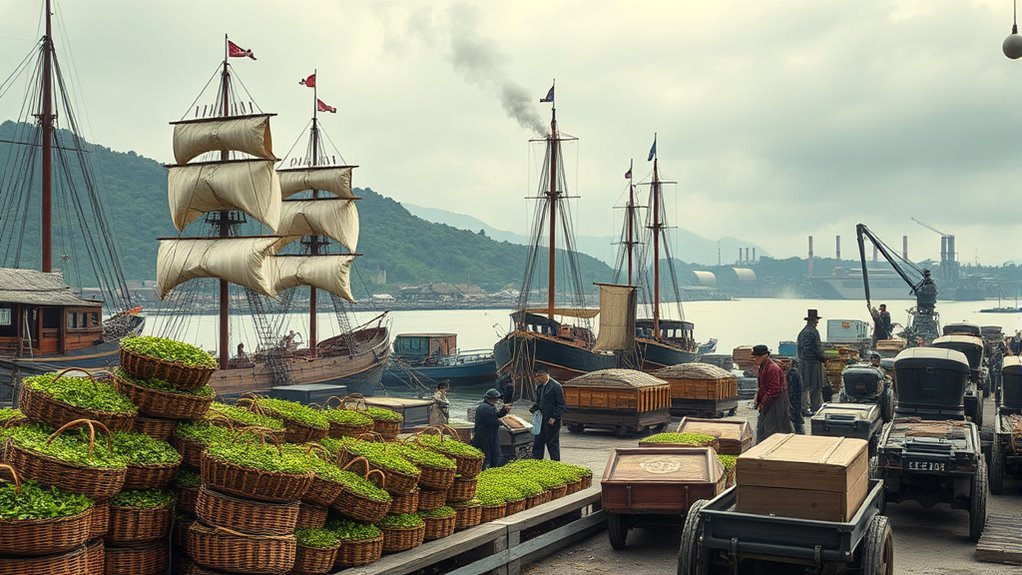

The history of tea trade and economics shows how it evolved from ancient Chinese cultivation, spreading through trade routes like the Silk Road and maritime routes to Europe and beyond. European traders, especially the British, established plantations and transportation systems that boosted global demand. Trade innovations and technological advances fueled a massive economic impact, transforming tea into a key global commodity. If you want to understand how tea became a worldwide industry, exploring its journey reveals fascinating economic and cultural shifts.
Key Takeaways
- Tea cultivation originated in China and spread across Asia, becoming vital to regional economies and agricultural practices.
- Trade routes like the Silk Road and maritime pathways facilitated the exchange and dissemination of tea and cultural ideas.
- European traders established maritime routes, leading to the global spread of tea and the development of colonial plantations.
- The rise of international demand fueled economic growth, infrastructure development, and complex trade systems centered around tea.
- Technological advancements in shipping and navigation accelerated tea transportation, solidifying its role as a major global commodity.

The history of the tea trade reveals a fascinating story of economic growth, cultural exchange, and global interconnectedness. As you explore this history, you’ll see how tea cultivation played a essential role in shaping economies and societies. Originally, tea was cultivated in China, where ancient farmers learned to grow and process the leaves, developing techniques that would later spread across Asia. Over time, tea cultivation expanded beyond China’s borders to regions like Japan, India, and Southeast Asia, each adapting methods suited to their climates. This cultivation was not just about growing a beverage; it became a cornerstone of local economies, providing livelihoods for countless farmers and workers.
Trade routes became the arteries that carried tea from its origins to distant markets, fueling its popularity worldwide. The Silk Road, an ancient network of trade routes, initially facilitated the exchange of tea between China and Central Asia, and eventually across Persia and Russia. As maritime trade grew, so did the importance of sea routes. European traders, especially the British and Dutch, established routes through the Indian Ocean, linking Asian tea-producing regions directly to European markets. These trade routes weren’t just pathways for goods—they were channels of cultural exchange, introducing new customs, tastes, and ideas along with the tea itself.
The expansion of trade routes was driven by the high demand for tea in Europe and North America. This demand led to increased production and intensified the use of trade routes, which in turn stimulated economic growth in Asian regions. The British East India Company, for example, played a pivotal role in establishing tea plantations in India, transforming local agriculture and trade. These plantations were built specifically to meet the growing appetite for tea, and their success depended heavily on the efficiency of trade routes that transported the harvested leaves to global markets.
As you consider this development, it’s clear how intertwined tea cultivation and trade routes became in shaping the global economy. The flow of tea across continents didn’t just satisfy consumer demand; it also created complex economic systems involving shipping, taxation, and trade policies. This interconnected network helped establish tea as a staple commodity, influencing everything from local livelihoods to international diplomacy. Without these trade routes, the widespread popularity of tea wouldn’t have been possible, emphasizing how essential infrastructure and geographic pathways were in transforming a local Chinese tradition into a global phenomenon. Additionally, the development of high-quality shipping technology and navigation techniques further facilitated the rapid and large-scale movement of tea, reinforcing its global significance.
Frequently Asked Questions
How Did Tea Influence Global Trade Routes Historically?
Tea cultivation markedly shaped global trade routes by creating demand that expanded shipping networks. As tea became popular in Europe and beyond, traders established routes connecting China, India, and Britain, boosting maritime commerce. You can see how trade routes adapted and grew to meet the high demand for tea, transforming global commerce. This influence continues today, highlighting tea’s role in shaping international trade paths and economic exchanges throughout history.
What Role Did Colonial Powers Play in Tea Expansion?
Colonial powers played a key role in tea expansion by establishing colonial monopolies and enforcing trade regulation policies. They controlled tea production and trade, ensuring their nations benefited economically. These powers set tariffs, limited local competition, and secured exclusive trading rights, which boosted their influence. Your understanding of this highlights how imperial strategies shaped global tea markets, making colonial dominance essential for expanding tea’s reach worldwide.
How Have Tea Economies Impacted Local Cultures?
You’ll notice that tea economies deeply influence local cultures by shaping tea cultural practices and social rituals. As tea becomes a central part of daily life, it fosters community bonding and traditional ceremonies. These social rituals, rooted in historical practices, evolve with economic changes, but they always emphasize hospitality and respect. You’ll see how tea’s economic importance helps preserve unique cultural identities while also adapting to modern influences.
What Technological Advances Affected Tea Trading Methods?
Think of the tea trade as a well-oiled machine. Technological advances like steam-powered engines revolutionized transportation, making it faster to move tea cultivation and processing tools. Innovations in tea processing, such as mechanized rolling and drying, boosted efficiency and quality. These advancements allowed traders to meet soaring demand, transforming tea into a global commodity and shaping the way you enjoy your favorite brew today.
How Did Tea Pricing Fluctuations Influence International Markets?
You see that tea pricing fluctuations cause significant market volatility, impacting international markets. When prices rise sharply, traders often adjust their pricing strategies, leading to shifts in supply and demand worldwide. These fluctuations can cause sudden changes in tea exports and imports, affecting economies dependent on tea trade. As a result, market stability becomes challenging, and stakeholders must continuously adapt their strategies to manage risks associated with unpredictable pricing swings.
Conclusion
Imagine the tea trade as a mighty river, flowing through centuries, shaping economies and cultures along its banks. As you navigate its currents, you see how each tributary—trade routes, innovations, and markets—builds the mighty flow that connects nations. Just like a river’s relentless journey, the tea trade’s history reminds you that persistence and adaptation forge powerful currents, transforming simple leaves into a global economic force. Your understanding becomes part of this ongoing, flowing story.